Salmon Enhancement Program
For more than 40 years, the Suquamish Tribe has been dedicated to protecting and enhancing salmon populations throughout the Pacific Northwest. Through a network of hatcheries, rearing facilities, and marine net pens, the Tribe’s Salmon Enhancement Program supports ceremonial, subsistence, and commercial harvests while contributing to the long-term recovery of natural salmon stocks.
Facilities & Operations
The Salmon Enhancement Program is operated by a team of experienced staff who manage:
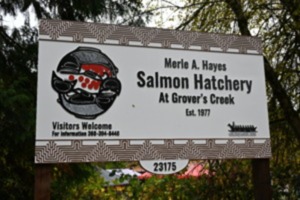
- Merle A. Hayes Salmon Hatchery (formerly Grover’s Creek Hatchery), established in the late 1970s. This facility became fully operational in the early 1980s, replacing the nearby Cowling Creek Hatchery, and serves as the primary site for Tribal salmon enhancement activities.
- Gorst Creek Rearing Facility, located in South Kitsap County, was founded in the 1970s through a partnership with the Kitsap Poggie Club and Washington Department of Fish and Wildlife. It serves as a rearing site for juvenile salmon.
- Marine Net Pen Facilities, located in Agate Pass and Elliott Bay. These pens allow young salmon to acclimate to saltwater before their release into Puget Sound.
Together, these facilities release millions of salmon each year and work alongside regional partners, including the Muckleshoot Indian Tribe, Minter Creek Hatchery, and local community organizations.
Salmon Species & Life Cycle
Each year, the program releases:
• 2.5 million Chinook (King) salmon (Oncorhynchus tshawytscha)
• 2.2 million Chum (Dog) salmon (Oncorhynchus keta)
• 1.4 million Coho (Silver) salmon (Oncorhynchus kisutch)
After spending several years at sea, these salmon return to their release sites. On average, annual returns include about 2,000 Chinook, 10,000 Chum, and 2,000 Coho.
Return timing varies by species:
• Chinook arrive in early September, often seen powering upstream through narrow creeks.
• Chum return in larger numbers from October through November.
• Coho arrive throughout the fall, developing a deep red coloration as they prepare to spawn.
Scientific Monitoring
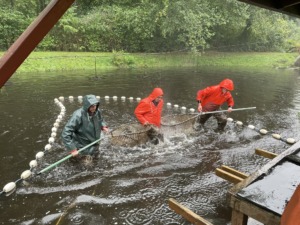
The Suquamish Fisheries Department carefully monitors both juvenile and adult salmon to protect populations and uphold Tribal treaty rights. Hatchery-raised Chinook and Coho are implanted with Coded Wire Tags (CWTs) and have their adipose fins clipped before release. Upon return, fish are scanned and tags are retrieved to gather data including:
- Hatchery origin
- Brood and release year
- Return location
This information helps biologists track survival and migratory patterns while ensuring biodiversity through controlled fertilization and small-batch spawning.
Education & Community Outreach
The program also plays an important role in education and community connection:
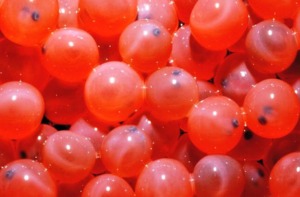
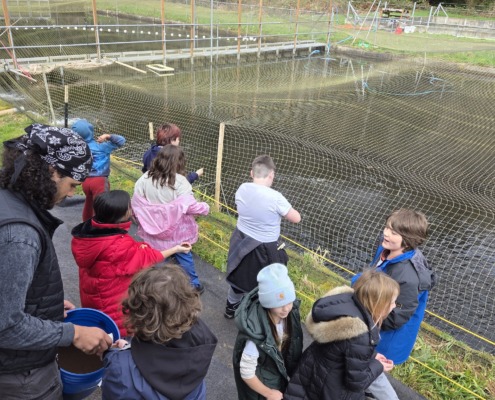
• Salmon in the Classroom programs support student learning with real eggs and hands-on science
• Public tours raise awareness about salmon ecology and Tribal stewardship
• Community events are supported with salmon provided by the program
• Egg sharing with partner hatcheries helps strengthen regional salmon populations
Stewardship & Partnerships
Collaboration is central to the program’s success. The Tribe works with neighboring Tribes, agencies, and nonprofits—including the Kitsap Poggie Club—to promote conservation and volunteer involvement.
The Merle A. Hayes Salmon Hatchery facility at Grover’s Creek continues to play a vital role in salmon recovery within the Port Madison Indian Reservation and beyond.
Frequently Asked Questions
Where is the Merle A. Hayes Salmon Hatchery?
23175 Indianola Rd NE, Poulsbo, WA 98370
When can I get salmon?
Salmon distribution takes place Monday, Wednesday, and Friday during spawning season (typically September through December). The hatchery opens at 8am and spawning begins at 9am. Salmon are distributed on a first-come, first-served basis while supplies last.
What happens to wild salmon?
Wild Coho salmon, identified by an intact adipose fin, are carefully transported upstream to spawn naturally. Hatchery fish are marked with a missing adipose fin.
How can I volunteer?
The Suquamish Hatchery works in partnership with the Kitsap Poggie Club, which offers volunteer opportunities and outdoor family activities throughout Kitsap County. You may also apply to be a volunteer specifically with the Suquamish Tribe by signing up here!
I have questions that aren’t answered on this page. Who can I contact?
Merle A. Hayes Salmon Hatchery (360) 394-8440