
By Jon Anderson
Suquamish News Staff Writer
The blankets, necklaces, handcrafted gifts and other offerings spread across the House of Awakened Culture on Oct. 14 represented more than souvenirs from another Tribal Canoe Journey.
Each carried a message of gratitude.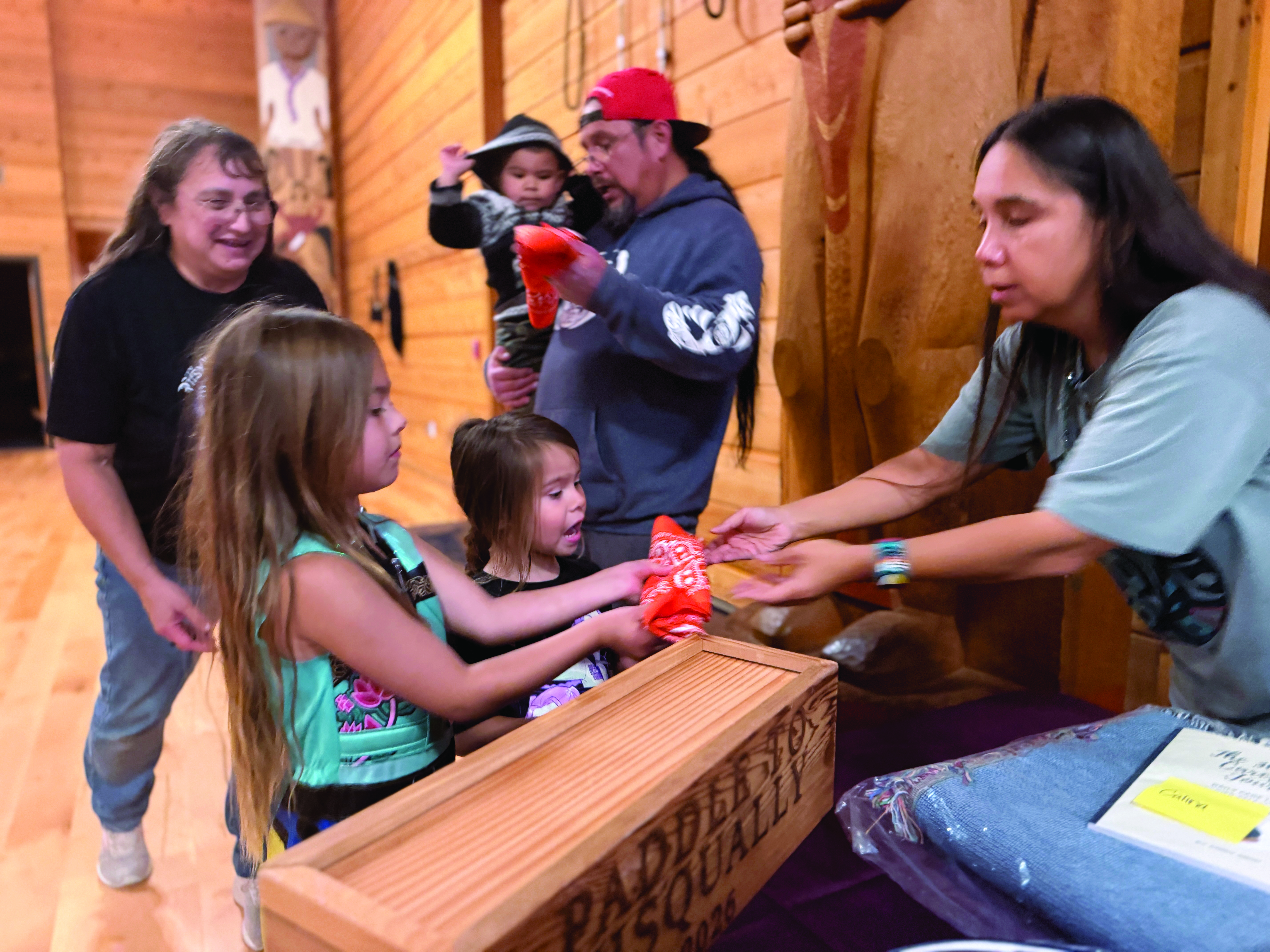
One by one, community members stepped forward to be recognized for their contributions to this summer’s Journey — from welcoming visiting canoe families to Suquamish shores to pulling canoes south to Nisqually, preparing food and sharing songs and dances during five days of protocol.
There were gifts for skippers, pullers, Elders, language speakers, cooks, fishermen, veterans and volunteers. Some had helped lead major portions of the Journey. Others worked quietly behind the scenes, making sure people were fed, camps were supplied and everything ran smoothly.
For the Suquamish people, such gatherings reflect traditions that extend well beyond Canoe Journey. Raising hands in thanks, honoring contributions, sharing gifts, shout-outs on Facebook and quiet whispers of “I appreciate you” all combine into a lived core value of caring for others woven throughout tribal community life.
And as November arrives, bringing celebrations of veterans, harvests and family, those traditions take on particular resonance during a season when many are reflecting on the people and blessings for which they are grateful.
A season of giving thanks
The Canoe Journey Honoring was one of several recent gatherings recognizing the people and contributions that strengthen the Suquamish community.
In recent months, the tribe celebrated volunteers whose time and dedication support tribal programs and community events. At September’s Salmon Homecoming in Seattle, Suquamish people joined others from across the Salish Sea to welcome the salmon home, giving thanks for their return.
More gatherings are planned in the coming weeks, including Veterans Honoring on Nov. 11 at Kiana Lodge and Harvest Fest on Nov. 14 at the House of Awakened Culture.
November also brings Thanksgiving, a holiday embraced by many Suquamish families as a time for gathering and sharing food, while others approach it with more complicated feelings because of its colonial history. Some prefer to call the fourth Thursday of November Feast Day.
But Suquamish traditions of honoring others, sharing gifts and giving thanks reach much further back than any American holiday — and extend far beyond a single day on the calendar.
Gratitude in motion
For Suquamish Tribal Council Member Azure Boure, who also leads the tribe’s Traditional Foods and Medicine Program, gratitude is about more than giving thanks. It’s about sharing what the land and water provide, honoring those who came before and passing those traditions to future generations.
“For Suquamish people, giving thanks isn’t something we do just once a year. It’s part of how we live and how we take care of each other,” Boure said. “When we harvest, we’re grateful for what the land and water provide. When we gather, we share that abundance with our families and community. And we honor the people who taught us these ways so we can pass them along to the next generation.”
Those traditions will be celebrated at the tribe’s annual Harvest Fest, where community members will gather for a traditional meal, hands-on cultural activities and friendly competitions.
This year’s featured activity will be making bison summer sausage from meat Boure obtained through a cultural exchange for Suquamish king salmon. Participants can take their sausage home to cook or smoke.
Other activities will include cedar pounding, beading and traditional skills demonstrations, with Lushootseed incorporated throughout the event. Berry pie and smoked salmon contests are also planned.
Boure said Harvest Fest is as much about recognizing the people who share their skills as it is about learning something new.
“The sharing of knowledge is a domino effect,” she said. “Maybe it will spark something else, and maybe that will spark something new, and then they’ll have their own ideas.”
Passing knowledge to the next generation
That connection between gratitude and sharing knowledge was also on display recently when Chief Kitsap Academy students headed out on the water for the annual Ocean to Table program.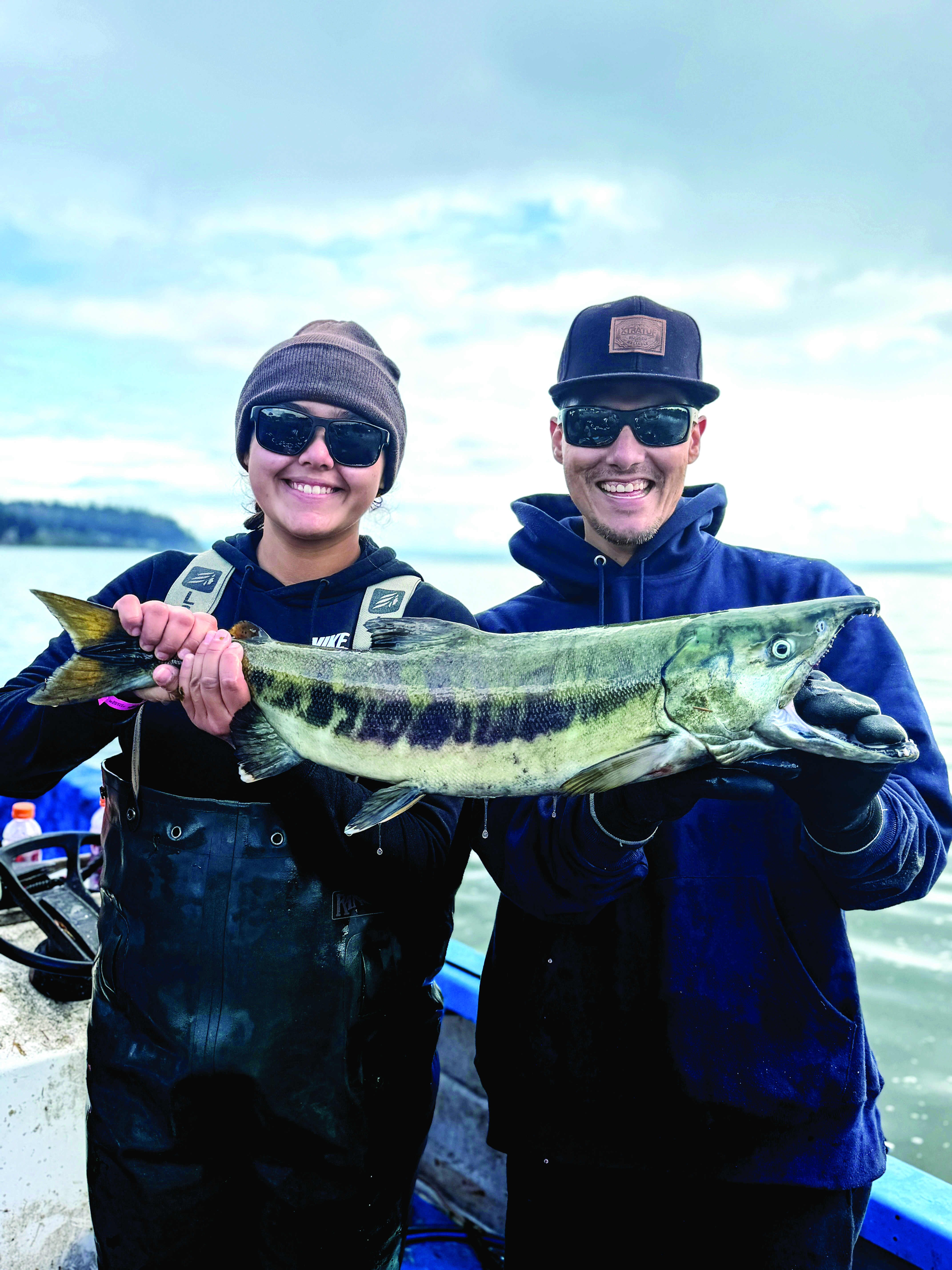
Standing in Miller Bay in water well past her waist, student Shaunie Cordero helped haul a long seine net toward shore alongside her classmates.
Her father, Suquamish fisher Michael Cordero, had been working from a skiff, helping carry the net out before circling back as the students brought in the salmon.
With the first catch ashore, father and daughter paused for a photo.
“This is a highlight of the year right here,” Michael said, wrapping an arm around his daughter.
For Suquamish fisher Shellene George, who was helping mentor the students, the day offered a chance to pass along knowledge gained over years on the water.
“I’m grateful for this opportunity. I’m grateful that I have the teachings and to be able to give these kids my knowledge,” George said. “I’ve hit a certain place in my life where I’ve realized whatever that I had wasn’t good for just me anymore. It was only good if I could give it away.”
George has participated in Ocean to Table for several years, watching former students go on to work in the seafood industry, with some returning to help teach the next generation.
“It’s a full circle,” she said. “And it’s beautiful.”
Honoring those who make it possible
Back at the House of Awakened Culture, the Canoe Journey Honoring offered a glimpse of how many people contributed to the summer’s gathering.
Maintenance and Emergency Management staff were recognized for helping coordinate Suquamish’s hosting. Volunteers received gifts for harvesting and preparing food, organizing supplies, teaching songs and dances, and supporting canoe families.
Tribal Elders Patty Medina and Robin Camacho were among those thanked for preparing gifts and helping with Journey logistics. Skippers Ian Lawrence and Rob Purser also received special recognition.
Volunteer seafood harvesters were presented with handcrafted beaded feathers.
“This is out of our tradition and our culture that we go and feed our guests at this time, and it’s a sacrifice,” said Cultural Events Planner Hazle Pacquette, emphasizing that the ceremonial harvest was entirely volunteer work. “I hope that these bring you strength and keep you safe in your travels.”
Much of the work being honored had taken place beyond the spotlight of public ceremonies. On this evening, those contributions were brought to the center of the gathering.
Giving thanks across generations
Suquamish Language Program Coordinator Cassandra George offered another perspective on gratitude as she honored community members who spoke Lushootseed during the tribe’s hosting.
George recalled beginning to learn the language at age 11, following in the footsteps of those who worked to preserve and revitalize it.
“There are people before that made it possible for me to learn this language,” she told the gathering.
“This year was the first time I ever heard that many different people speak Lushootseed,” George said of the canoe arrivals.
She credited generations of families and teachers who preserved and shared cultural knowledge, often through years of dedication.
“The fact that we had so many Suquamish people speaking and welcoming our canoes this year, I think it’s important for us to say their names and honor those families, those parents, and anybody that encouraged their child or even an adult to learn the language,” she said.
George recognized more than a dozen community members who spoke Lushootseed during the July 27 canoe family arrivals, along with Charles Lawrence, who sent off more than 60 departing canoes in Lushootseed on July 29.
For George, honoring those speakers was also a way of thanking the generations who made their voices possible.
The gifts we give
As the evening continued, participants were invited to select gifts received from other canoe families throughout the Journey — jewelry, traditional medicines, preserved foods and handmade items.
Many, said Pacquette, had been made or selected with the intention of sharing the good feelings generated during the Journey.
“I hope that every one of you walk away with something that you can bring home, and you know that came from someone who was trying to share that peace and love with you,” said Pacquette.
During this year’s Canoe Journey hosting, Suquamish people welcomed canoes onto their shores in their language, and again as they departed. The amount of language speakers on the beach doubled from last year.
During the Canoe Journey honoring ceremony, Language Program Coordinator Cassy George read the names of those whose voices were heard this summer:
Josh Bagley
Shayna Bagley
Azure Boure
Isabelle Chiquiti
Genevieve Edwards-Boure
Leonard Foresman
Emmy Fowler
Cassy George
Celila’litsa Holmes
Denita Holmes
Joey Holmes Jr.
Charles Lawrence
Talynn Marquez
Ainslee Moss
Kinslee Moss
Zaylee Moss
Serene Williams
More than a season
Some expressions of gratitude are highly visible: gifts presented before an assembled community, Elders honored at special gatherings or veterans thanked for their service.
Others happen quietly, through a shared meal, a helping hand or knowledge passed from one generation to the next.
For Boure, the Suquamish tradition of raising hands in thanks captures the deeper meaning of all these gestures.
When raising hands to honor someone, she explained, the hands should be held above the heart.
“We are pouring our heart into thankfulness,” she said.
The gesture is also about lifting others up, recognizing their contributions and showing respect for what they have shared.
At the Oct. 14 Canoe Journey Honoring, the gifts were one way of recognizing what so many people had given. But the evening’s larger message was about something more enduring: a community lifting one another up in gratitude.

