
The Wisdom of Our Mothers
Across generations, Suquamish women pass along love, strength, stories and teachings that hold families together
By Jon Anderson
Suquamish News Staff Writer
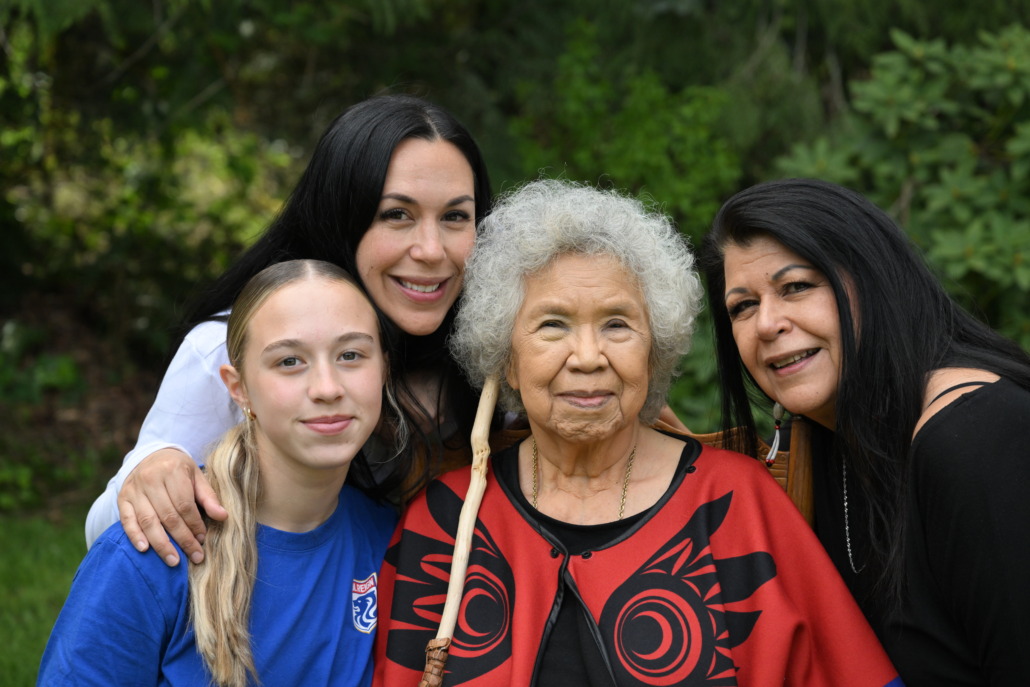
For Dolores Mills, the answer comes simply. What does it take to be a good mother? “Just to give lots of love,” she says with a twinkle in her eye.
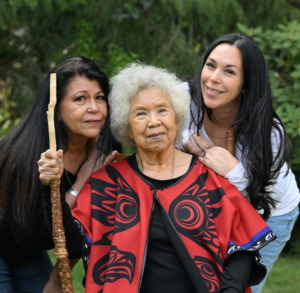
At 94, soon to turn 95 on May 18, Mills has spent nearly a lifetime doing just that. The Suquamish Tribe’s eldest female Elder is mother to six, grandmother and great-grandmother to many more, and the quiet center of a large family that still turns to her for prayer, comfort and steadiness.
Her daughter Lori Bakken does not hesitate when asked what her mother means to the family. “She’s the glue that keeps us together,” Bakken says.
Her mom was just one of many strong Suquamish women who Bakken drew knowledge, inspiration, and her own strength from.
“We grew up watching Great Grandma Cecilia clean her wool with the paddles and weave. She’d make wool socks, she’d make the wool sweaters, the wool hats,” says Bakken. “She taught me how to basket weave. I remember sitting on the floor of her little pink house on Phinney Bay right next to a rocking
chair. It always smelled like cedar and cattails. And she was always teaching us something.”
That kind of wisdom — steady, generous and enduring — lives at the center of many Suquamish families. It is passed along in quiet ways, through daily care, shared meals, prayer and presence.
Learning together
For Lori’s daughter Brittany Bakken, those lessons began early — not just at home, but out in the community.
As a child, Bakken was part of a group of Suquamish girls who gathered regularly with Auntie Betty Pasco. Known simply as Kaya’s Girls — a circle of young women learning together — it became a place where culture and life skills blended naturally.
They learned weaving, cooking and how to care for family. They heard stories. They spent time together not just as classmates, but as relatives.
“It wasn’t just one lesson,” Bakken says. “It was everything.” Those gatherings, along with time spent with her grandmother and extended family, helped shape how she sees motherhood today — as something rooted in connection, not isolation.
Stories that teach
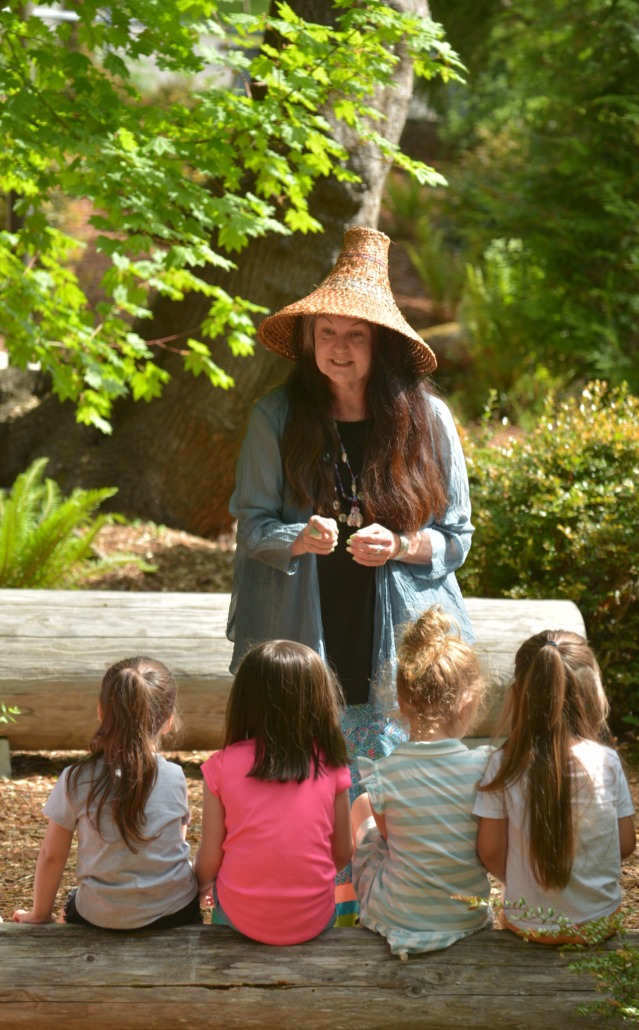
For Barbara Lawrence, those lessons often came through story.
Recalling childhood days spent clam digging and berry picking, “I thought the stories were entertaining us through drudgery,” she says. “And then I realized,” she says, with a pause, “the stories were teaching us something deeper.”
A child acting up might hear a story that mirrored their behavior. Lessons about respect, responsibility or consequences were woven into narratives, allowing children to recognize themselves without being singled out.
It was a way of learning that stayed with you. Those teachings were not passed down by one person alone. Lawrence said she was raised by a network of women — her mother, aunties and Elders — who all played a role. who all played a role. That shared responsibility, she said, is part of what defines tribal motherhood, says Lawrence.
A mother’s lesson, carried forward
For Lawrence’s son, Ian Lawrence, those teachings showed up in ways that shaped how he understands the world. Among many moments that have stayed with him for years, he remembers as a teenager walking through the Peninsula College parking lot and noticing something small, but seemed unusual to him. A woman was looking in the back of her car before she got into it.
When he pointed it out to his mom, she explained most women do that. “Let’s sit and watch,” she told him, motioning them over to a park bench. Sure enough, woman after woman looked in the back seat of their car before getting in.
“Son, these are all women who have either been attacked, know someone who has, or have been taught to do this,” she told him. “That was a really big lesson for me,” he says. “Even though I’m not that guy, just being a guy, having a deeper voice, being larger than most women — it’s easy to intimidate them without meaning to.”
It was a difficult realization, but an important one. It taught him awareness, respect and responsibility — lessons he carries into his life today as a father, carver and canoe skipper.
Learning how to show up
For Cori Silvey, motherhood has been shaped as much by what she learned from others as by her own experience.
As a teenager, she spent time babysitting across the tribal community, including caring for children who would later become part of her daughter’s extended circle.
One of those relationships came full circle years later, when Lenora Bagley asked if she could be part of her daughter Jurnee’s life.
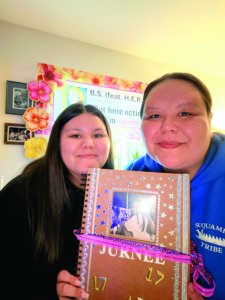
“She asked if she could be her auntie,” Silvey says. It wasn’t assumed. It was intentional. Lenora showed up — taking Jurnee to the park, setting up playdates and creating space for her to just be a kid while Silvey balanced work, school and parenting.
That experience has help reshape how she thinks about community and motherhood — not as something one person carries alone, but as something shared.
Silvey continues to learn from the mothers around her — older and younger — often through quiet moments of observation. “I needed somebody to show me,” she said. “Not tell me.”
Now, as Jurnee turns 17, those lessons are still unfolding. For her daughter’s birthday, Silvey created a scrapbook filled with letters from family and loved ones — a collection of voices reminding her who she is and how deeply she is cared for.
Auntie Lenora wrote that she was about Jurnee’s age now when she first committed herself to becoming a steady presence in her life.
Meanwhile, with her own daughter transitioning into adulthood, Silvey is navigating what it means to parent in a modern world.
She maintains a TikTok account where she shares moments from Jurnee’s life — always with permission — finding ways to celebrate her while staying connected.
It’s a balance between old and new, between traditional teachings about respect, boundaries and care, and the realities of growing up in a digital world.
The thread that holds it together
Across generations, the form may change, but the core remains. Mothers, aunties and grandmothers teach through example. Stories carry lessons. Community steps in where needed.
Love is expressed through action. It shows up in a grandmother’s prayers, in a mother’s open door, in an auntie who makes time, in a quiet moment of guidance that stays with someone for life.
And sometimes, it can still be said in the simplest way possible. Just give lots of love.

