
Suquamish Police Advisory Committee helps rebuild bridges
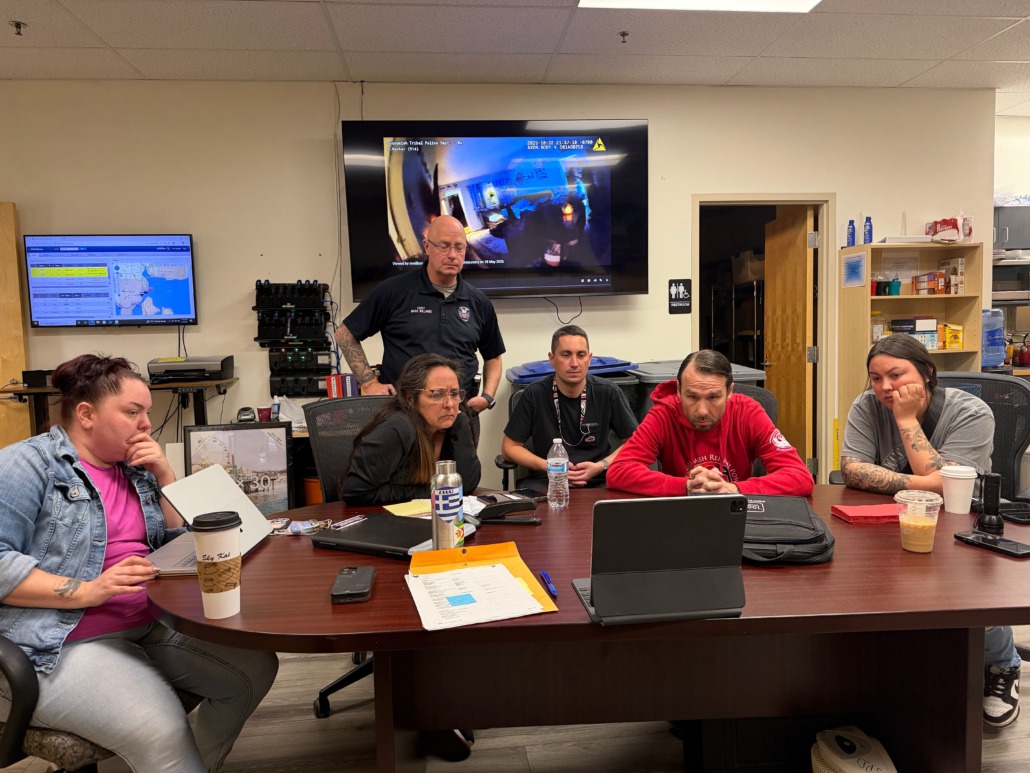
As Suquamish Police Chief Mark Williams stood near a large screen inside the department’s conference room, five tribal members in the Suquamish Police Advisory Committee leaned forward in silence, watching body camera footage from a recent domestic violence call.
The room was quiet except for the voices coming from the video.
The committee members watched carefully as officers responded to a tense situation of alleged late-night domestic violence, eventually wrestling a suspect to the floor and making an arrest. It’s the kind of police work that most community members never see firsthand.
The Suquamish Police Advisory Committee is one of the newest boards and committees appointed by Suquamish Tribal Council. Currently the committee includes Chair Brittany Dumford, Ah-nika-leesh Chiquiti, Kayla George-Purser, and JoAnn Joe, along with Tribal Council Liaisons Josh Bagley and Andrew George.
“Historically, there wasn’t a great relationship between tribal members and our police force,” Bagley said. “It’s a lot better now, and I think that’s why we have this committee – to improve that relationship and continue to make it better.”
Bagley said the advisory board provides accountability while also helping police and community members better understand each other.
“I think we also need it just so we have a healthy check on our police,” Bagley said. “Just with all the stuff that goes on with cops in general these days, I think it’s good to have tribal members work with the chief and make sure our cops are doing the right things, and de-escalating the way tribal members want them to whenever possible, and – when necessary – arresting people in the right way.”
The group meets monthly at the Suquamish Police Department and serves in an advisory and oversight role focused on public safety, police practices, and communication between the department and tribal members.
Some of the committee’s most important discussions happen while reviewing use-of-force incidents. Williams said the process has helped strengthen trust between the community and the department.
For Williams, that transparency is exactly why the committee exists.
“It boils down to the police department works for the people,” said Williams. “So, the people need a voice in their police department and eyes on the work we do.”
In addition to giving committee members a behind-the-scenes look at police work, the meetings also provide a chance to review plans SPD is working on.
During the recent meeting, for example, Williams briefed the committee on several department initiatives and updates, including:
- New K9s: The department is seeking funding for a narcotics detection dog and is also moving forward with an emotional support dog that would spend time interacting with community members.
- Officer training: The department is reevaluating where officers attend the Basic Law Enforcement Academy, moving forward with plans to send them instead to one of two federal academies. Suquamish Police Advisory Committee helps rebuild bridges between Police Department and tribal community
- Traffic investigations: Marine Division Officer Simeon Barker is receiving advanced collision investigation training through the Kitsap Integrated Traffic Task Force to help the department handle serious injury and fatal crashes.
- Recruitment and staffing: Williams told the committee the department is expected to be fully staffed for the first time in years.
Unlike many tribal boards and committees, Police Advisory Committee meetings are not open to non-committee members because of the often-sensitive nature of the information being reviewed, including body camera footage, police reports, and discussions involving use of force incidents.
Still, tribal members can always request time on the agenda – to raise concerns, ask questions, or offer suggestions – by contacting committee Chair Brittany Dumford. Williams also has an open door policy for any member of the tribal community who would like to speak with him.
For Bagley, the committee’s work ultimately comes down to continuing to improve the relationship between the department and the community it serves.
“It should never be an ‘us and them’ feeling between the tribal members and the police,” Bagley said. “It should always be they’re a part of us. And now, I think, it has become exactly that.”

