
Bridging Both Sides of the Water
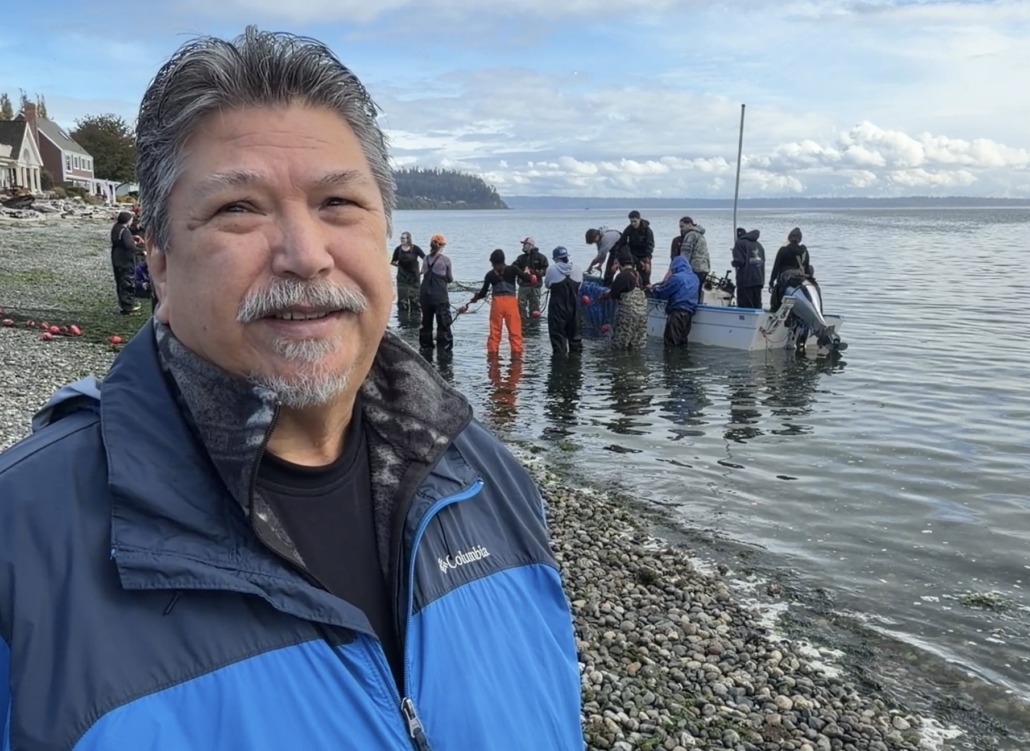
On a cool late October morning, Suquamish Tribal Council Member Luther “Jay” Mills joins students from Chief Kitsap Academy and Seattle’s Ingraham High School on the water for a lesson in traditional salmon harvesting.
For Mills, the annual Ocean to Table program is about much more than catching fish. It’s an opportunity to pass along knowledge he learned from his great-grandmother and other family members. It’s about teachings passed from one generation to the next.
This year’s participation by students from Seattle also reflects another important part of Mills’ work: strengthening the connections between the Suquamish Tribe and the city built on its traditional territory and bears the name of the tribe’s most famous ancestral leader, Chief Seattle.
After decades of helping build tribal enterprises, preserve cultural traditions, and advocate for the tribe’s interests on the Port Madison Reservation and across Kitsap County, Mills is increasingly focused on ensuring that Suquamish history, identity, and treaty rights are understood and respected across the Puget Sound in Seattle as well.
A lifetime of service
Mills’ involvement in tribal government and business stretches back nearly half a century.
He remembers working at the early modest tribal smoke shop, serving as a night watchman and caretaker, and watching the tribe build the businesses and government institutions that would help transform its economic future.
First elected to Tribal Council in 1984, Mills has served through the years by playing his part to help guide the tribe through enormous growth.
Today, he continues that work through his roles on Tribal Council, as with Port Madison Enterprises, and as a cultural ambassador sharing Suquamish foods, traditions, and history.
That work has taken him as far as Washington, D.C., where he and other Suquamish representatives have served traditional seafood at the National Oceanic and Atmospheric Administration annual fish fry hosted by the U.S. Commerce Department.
It’s an opportunity to showcase the tribe’s seafood industry while telling the story of the Suquamish people and their treaty-protected rights to harvest the resources that have sustained them for generations.
But some of his most important work as an ambassador is taking place much closer to home.
Telling the Suquamish story in Seattle
In 2022, Mills was appointed the City of Seattle’s newly formed Indigenous Advisory Council, to help city leaders better understand the history, rights, and continuing presence of Native peoples.
“I’m trying to tell our story to people that I think would make the difference, and that includes the mayor, the City Council, and city staff,” Mills said.
He sees the advisory council as an important opportunity to do just that, not simply by educating city officials about history, but by ensuring that tribal perspectives are considered in decisions being made today.
For Mills, that work carries particular importance because the Suquamish Tribe’s ancestral territory extends into what is now Seattle.
While the tribe’s government and reservation are based in North Kitsap, its ancestral connections to Seattle are deeply rooted in the history of Chief Seattle himself.
“Chief Seattle was both Suquamish and Duwamish. The city is built on land that included both Suquamish and Duwamish villages,” said Mills. After the Treaty of Point Elliott was signed in 1855, many of the Duwamish people moved to the Port Madison Reservation. Some also went to other reservations in Puyallup, Tulalip, Lummi, and Muckleshoot.
“My lineage is Duwamish,” said Mills. In fact, each member of the Suquamish Tribal Council have Duwamish ancestry. The chair of the Duwamish Tribal Organization, a non-profit group in Seattle, is an enrolled Suquamish Tribal Elder.
Mills says many people in Seattle have little understanding of those connections. But that’s been changing. “When someone asks why there isn’t Duwamish representation at, say, a meeting in Seattle, I say ‘they do, it’s me. I am Duwamish.’”
Treaty Protection in Seattle
Meeting regularly at Seattle City Hall, the Indigenous Advisory Council brings Native representatives together with city staff to discuss issues ranging from environmental protection to public services and the use of public lands.
Mills says the relationship has evolved, with city departments increasingly seeking Indigenous input before launching projects rather than waiting until plans are already underway.
“It’s finally at a point now where they’re asking before projects begin,” he said. “That’s what consultation is supposed to look like.”
One example involves efforts to work with Seattle Parks and Recreation on policies that would allow tribal members to gather traditional plants in city parks, a practice generally restricted under existing rules.
Mills recently raised the example of a Suquamish tribal member gathering nettles and potentially facing a citation for exercising a traditional treaty-protected practice. Now, discussions include developing language similar to federal policies recognizing tribal gathering rights.
Environmental protection is another priority. Mills regularly reminds city leaders that Suquamish treaty rights are about more than fishing and hunting. They also depend on protecting the waters and habitats that sustain those resources.
“Where do you think all this runoff goes?” he said, describing conversations with Seattle officials. “It goes right down into Elliott Bay.”
For Mills, protecting those waters is a shared responsibility, one that benefits tribal members and their neighbors alike.
Raising the Suquamish flag in Seattle
Beyond strengthening relationships with city government, Mills has a larger vision for the tribe’s presence in Seattle.
He would like to see the Suquamish Tribe establish a permanent presence in the city — a visible place where the Suquamish flag flies proudly, while also providing services to tribal members and tribal businesses. The right location could include space for government offices, cultural education, and opportunities to showcase Suquamish artists and seafood products.
A permanent Suquamish presence in Seattle, said Mills, would provide a tangible reminder that the tribe’s relationship with the city is not simply a matter of history, but a living connection that continues today.
Passing it forward
That connection between past and present is also at the heart of Mills’ work with young people.
Growing up, he learned traditional fishing and seafood preservation practices from family members whose own memories reached back to a very different era in Suquamish history.
His great-grandmother Cecilia Jackson lived to be 103, and Mills remembers listening to her stories and learning the painstaking details of preparing fish for smoking.
Back out on the water, he finds himself passing those same lessons along to students through Ocean to Table.
Back on the beach, with the Seattle skyline peeking through the morning haze across the water, Mills watched students from Chief Kitsap Academy and Seattle’s Ingraham High School work together to haul in the seine nets.
For Mills, the scene brought back memories of his childhood on Phinney Bay, where he helped his family prepare salmon for smoking. His cousin Henry Jackson would arrive with a truckload of fish, sometimes 150 to 200 at a time, and the family would set up tables for cleaning and processing the catch.
One of Mills’ first jobs was gathering lady ferns to spread across the tables, keeping the slippery fish in place.
Decades later, Mills was watching his grandchildren take part in the same traditions. He counted six generations of his family, from his great-grandmother Cecilia Jackson to his grandchildren on the beach.
The presence of Seattle students added another dimension. School administrators had visited Ocean to Table the previous year. Now their students were experiencing the harvest alongside Suquamish youth.
“It’s another way to bridge the gap,” Mills said. “It’s another way to hopefully have these traditions continue on. You don’t have to be just Suquamish to do this.”
For Mills, the opportunity to share those experiences reaches beyond the students themselves. They will return to Seattle with firsthand knowledge of Suquamish fishing traditions and stories to share with their families and friends.
And for a man whose work has long connected the Suquamish Tribe with the city across the water, that is another way of bringing the two communities together.
Whether he’s teaching students to prepare salmon, helping city officials understand treaty rights, or advocating for a permanent Suquamish presence in Seattle, the underlying purpose is much the same: ensuring that the knowledge, traditions, and sovereignty inherited from previous generations remain strong for those yet to come.

