
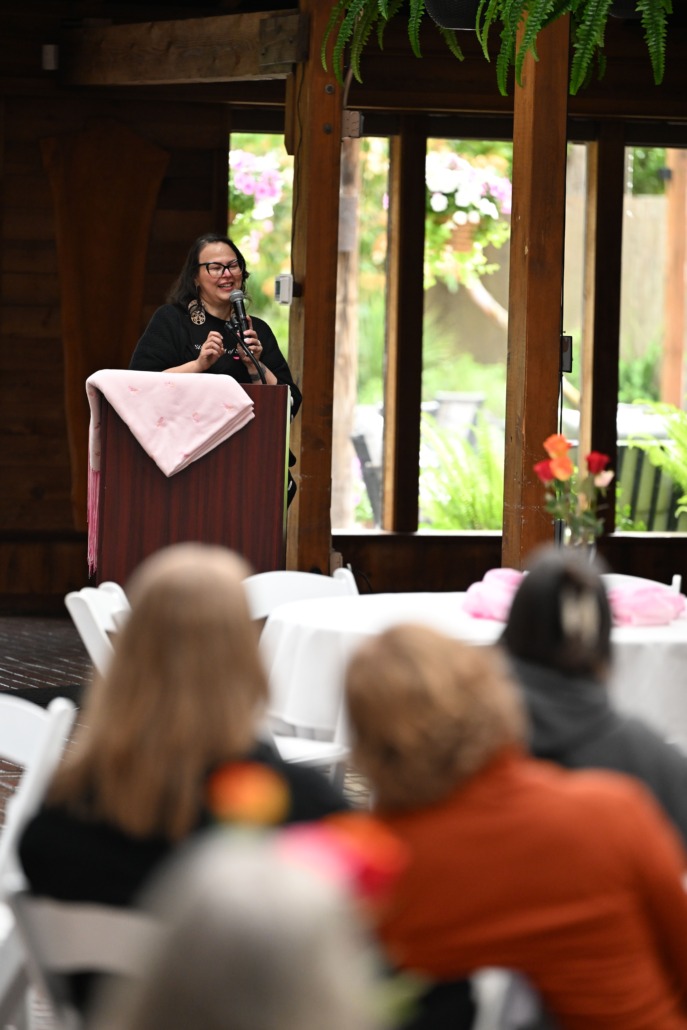
How constellations of care helped save Robin Sigo’s life
When Robin Little Wing Sigo sat alone in a Seattle imaging center last summer, waiting to learn whether a second round of scans would confirm her fears, time seemed to narrow into two doors.
One door led back to normal life.
The other would change everything.
“In five minutes,” she told the crowd gathered at the Women’s Health Fair at Kiana Lodge in May, “they were determining what the next steps of my life were going to be.”
Sigo, a former Suquamish Tribal Council member and co-founder of the Suquamish-based nonprofit SaltFire, publicly shared the story of her breast cancer journey during the event, which focused on women’s health, survivorship and prevention.
The moment she received her diagnosis remains vivid.
After an annual mammogram last June revealed abnormalities in her right breast, Sigo returned weeks later for additional imaging. At first, she tried to reassure herself.
“They can’t get me in for six weeks,” she recalled thinking. “Clearly this is not a big deal.”
You have cancer right here
Her fiancé, Randy, insisted on accompanying her to the appointment in Seattle. She initially told him there was no reason to come.
“I was like, ‘They’re not going to give me any answers,’” she said.
But after more scans and an ultrasound, a doctor entered the room and delivered the news directly.
“He said, ‘I’ve got to be really honest with you. You have cancer right here.’”
She immediately asked him to bring Randy in from the waiting room
“Tears are running down my face and, you know, it was a terrible moment, all these fears I’ve had all my life just welling up,” she said. “And then in comes my big burley Viking guy and he was not just there for me, but he was also able to ask all the questions that I wasn’t able to even think of in that moment. I was so grateful for that.”
The diagnosis came after decades of work connected to health and wellness in the Suquamish community.
Sigo first began working for the Suquamish Tribe nearly 27 years ago, originally planning to stay only for the summer. Instead, she built a career rooted in community health, social work and trauma-informed care.
Early in her career, she helped administer health grants related to diabetes prevention, breast cancer prevention, and public health outreach. She spent years encouraging women to schedule mammograms and preventative screenings, long before she imagined she would someday face cancer herself.
“My grandma had breast cancer,” Sigo said. “So I always knew I needed to get checked.”
Constellations of care
That background shaped how she approached the diagnosis. After the initial shock, she found herself thinking like a counselor and social worker, trying to gather information and prepare for what came next.
The long months that followed were both physically and emotionally exhausting. From July through September, she underwent additional testing, consultations and uncertainty before doctors confirmed the cancer was treatable and likely would not require chemotherapy.
“There are so many tests and so many things,” she said. “It becomes this constant process.”
Sigo received treatment through Virginia Mason, where she said coordinated care teams, navigators, and specialists helped guide her through surgery and recovery.
Equally important was the support surrounding her outside the hospital.
“There was something really amazing about this constellation of people that came out to help me,” she said, describing the family members, coworkers, friends, and community members who brought meals, donated money, checked in on her and sat with her during difficult moments.
Strength in our DNA
Throughout the process, Sigo also leaned on the resilience she believes is carried through generations of Native women.
“I’m proud to be a Native woman,” she said. “Because I know that living in our DNA, we have ancestors who made it through hard things.”
Now six months after her surgery, Sigo said she wanted to share her story publicly because too many people delay screenings, avoid appointments or try to face illness alone.
Her message to others was practical and direct.
- Get regular mammograms.
- Ask questions.
- Accept help.
- And don’t wait until things feel urgent before taking your health seriously.
She also encouraged people to recognize the emotional toll a serious illness places not only on patients, but on families and caregivers trying to process fear and uncertainty in real time.
Most importantly, she urged people to allow themselves to lean on community.
“There are people here to help,” Sigo said. “You don’t have to do it alone.”

