
More than a Monster
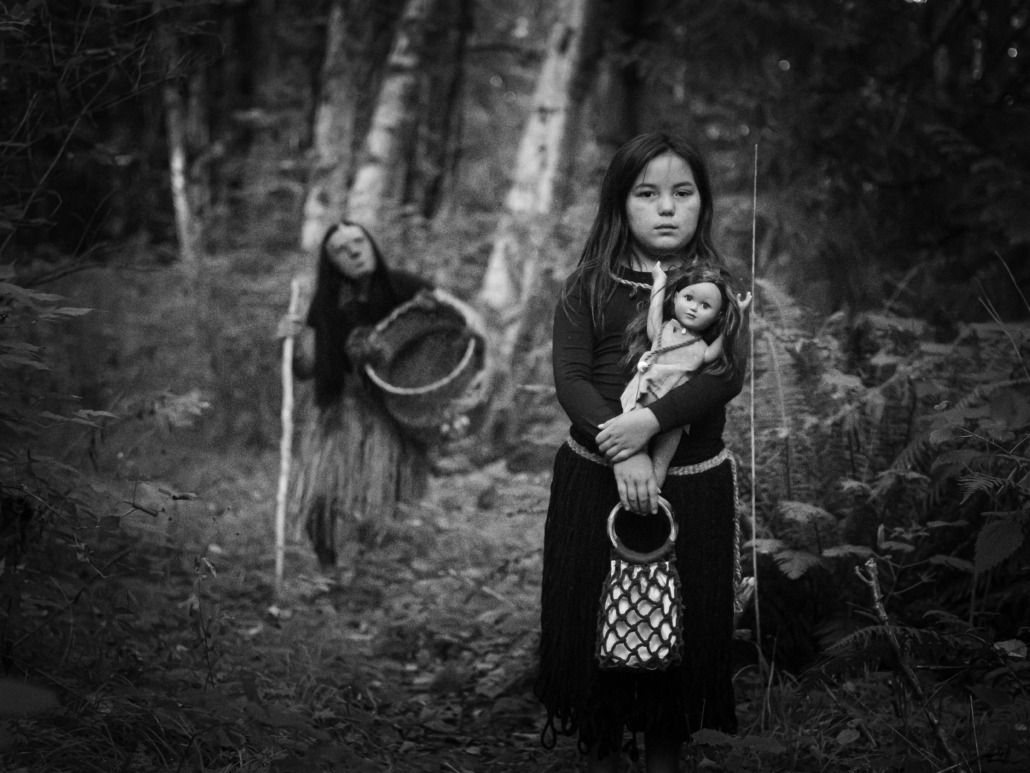
The Basket Ogress carries a basket big enough to hold children. And she is hungry.
Stray too far from your family, wander too deep into the woods, stop paying attention while picking berries, and you might and yourself inside it.
For generations, Coast Salish children have grown up hearing versions of this frightening story. Also known as the Basket Lady, she appears in a distinctly Suquamish telling as Snail Woman, hunched beneath the basket on her back.
The warning seems simple enough: Stay close. Listen to your elders. Be careful.
But listen again.
The children are not helpless. The ogress can be defeated. And the person who needs the warning might not be a child at all.
As fall brings longer nights and a taste for scary stories, the Basket Ogress is stepping into view in a variety of new ways throughout the Suquamish tribal community, including:
- An exhibit at La Galleria Art Gallery in Kingston featuring the work of four tribal artists set to premiere with a reception Oct. 3 from 4-6pm, and running through Jan. 3.
- A special “Stories by the Fire” night Oct. 8 at the House of Awakened Culture from 5-8pm.
- An upcoming children’s storybook produced by the Suquamish Tribe’s Education Division, now in search of a tribal artist illustrator.
For the people who grew up hearing about her, the story’s staying power comes from everything it can carry beneath the fright. Basket Ogress offers a way into something larger than a good scare, say tribal storytellers, and it’s just one of many traditional stories that teach young and old alike how to recognize danger, find their courage, and take care of one another.
The children fight back
Kate Ahvakana remembers listening to storyteller Johnny Moses on the beach as a child. Her mother, Peg Deam, brought storytellers and language speakers to Suquamish, and the family listened to recordings at home.
The Basket Ogress became a favorite. Years later, Ahvakana shared the story with her own daughter Shyla, who then began telling her friends at school.
For Ahvakana, the story holds more than instructions about behaving or staying out of the woods. It can help children think about situations they are not prepared for, people who might harm them, and decisions that carry consequences.
It also provides an example of children who overcome something terrifying.
In one version of the story, the ogress ends up in the fire, transforming into a swarm of mosquitoes.
“Being young, you can still fight back. You have a voice. You have a way to fight back,” Ahvakana says.
That is a different lesson from simply being afraid. The children recognize their danger and do something about it.
As listeners grow, other meanings emerge.
“If you hear a story for the fifth time, you’re like,‘I don’t remember that part,’ but now I remember it and I connect to it somehow,” Ahvakana says.
First, get their attention
Deam created her Basket Ogress coloring book during a period she remembers as a busy time of cultural renewal, when storytellers were sharing teachings across tribal communities.
Making a coloring book had long been something she wanted to do. When a publisher offered the opportunity, she photographed local children Lisa and Andrew Jackson as models for the illustrations. With help from Vi Hilbert and another language collaborator, the book included English and Lushootseed text.
Deam used herself as the model for the ogress. Initially, she drew herself much as she looked. Hilbert objected: The Basket Ogress needed to be ugly, a scary monster.
The story had to get its listeners’ attention.
“Fear is one of the storyteller’s tools,” Deam says.
A frightening story can also be fun, Deam says, offering another way to experience feelings and learn to deal with them. But its lessons can reach well beyond the initial scare.
“You can hear it on one surface level, but you can always go deeper,” she says. “What makes it scary?”
In the Basket Ogress story, children have gone somewhere their elders warned them about. They enter a place they do not understand, where they must figure out what to do.
“You always have a choice, but the more you know, the better off you will be maneuvering yourself through just being a human,” Deam says.
For an older listener, that unfamiliar territory might be a university far from home or a city full of strangers. The surroundings change. The need to recognize danger, understand people, and make decisions remains.
Recognizing the ogress
Deam suggests that a young person leaving home might encounter plenty of basket ogresses: people who take advantage of someone’s money, abilities, or kindness.
Learning to recognize them is one lesson. Recognizing those tendencies in yourself is another.
“Don’t use people because they have more money than you,” she says. “Or don’t bully someone because they’re different. Don’t become the Basket Ogress.”
In that telling, the story asks adults to consider their own behaviors as carefully as it asks children to consider their decisions.
That is part of what connects scary stories to a much wider body of teachings, Deam says. Stories carry recognizable human traits: generosity and selfishness, kindness and cruelty, laziness, gossip, and the willingness to help.
A character may remind a listener of a neighbor, a relative, or themselves. Recognizing that behavior creates an opportunity to decide what to do about it.
For Deam, these teachings reflect generations of people learning how to live together. They address the person who causes harm as well as the people affected by it.
“You don’t beat them up. You help them,” she says. “You help them understand. So many of our traditional stories come back to this recurring theme of what it meant to be a good human,” she says.
“And nobody finishes refining what that means,” Deam says. “Everybody should always be learning.”
What families carry forward
Lisa Jackson still has copies of Deam’s coloring book. She remembers posing on a beach log for the photographs, wearing her cedar regalia.
Today, she keeps the books as keepsakes. But she has chosen not to share the story with her young daughter.
“I don’t want to scare my kids into doing the right thing or making better choices,” Jackson says.
Her mother, Tina Jackson, told traditional stories, including a favorite about Blue Jay saving the sun. Scary stories were not part of their home life, Lisa Jackson recalls. For her own family, she emphasizes the cultural practices she knows best: weaving, canoe culture, song and dance.
Jackson still appreciates the Basket Ogress as art. Denita Holmes’ portrayal a few years ago remains one of her favorite Halloween creations.
The story can be treasured without every family telling it the same way—or choosing the same time to tell it.
A season to listen
For Ahvakana, fall brings people back together with plenty to share. Summer travels and canoe journeys become stories of their own. As the harvest season winds down and the nights lengthen, people reconnect through what they have experienced, as well as through teachings passed down to them.
What people bring home includes more than things they can touch.
“It’s stories and information,” she says. “Where we are coming back together and reconnecting in these ways.”
Storytelling has a place in everyday life, as well as in more formal gatherings. Stories also inspire carvings, weavings, books, and photographs. And they can travel with a child to school.
Ahvakana sees those connections in Denita and Joey Holmes’ new art exhibit set to open in Kingston dubbed “Basket Lady Returns.” A story told aloud becomes a cedar mask, a basket, and a figure among the trees. Someone encountering the art may find a new reason to listen.
And someone who has heard the story for the hundredth time may finally hear a piece that makes sense, Deam says. Experience gives listeners new ways to understand what has been there all along.
“You incorporate that into your life, and the understanding becomes deeper and deeper,” she says.
The Basket Ogress can get a child’s attention in an instant. Her teachings can continue long after that child has grown.
“They’re all saying the same thing,” Deam says. “Grow up to be a good person, and here’s how to do it.”
