
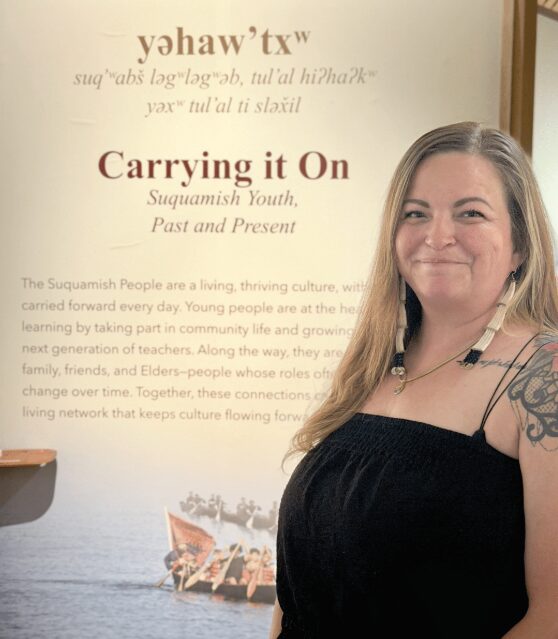
New Suquamish Museum exhibit explores growing up Suquamish
The newest exhibit at the Suquamish Museum invites visitors to do more than look at history — it encourages them to touch it, hear it, feel it and see themselves reflected in it.
“Carrying It On: Suquamish Youth, Past and Present” opened to the public June 12, offering an interactive exploration of what it means to grow up Suquamish. Co-curated by Museum Curator and Archivist Marta Belmont and Anna Mirzayan, the exhibit follows the journey of Suquamish youth from early childhood through ultimately becoming a revered Elder, examining the traditions, relationships and responsibilities that help shape identity.
“What family will they become part of?” Belmont asks. “Will they be a puller, a dancer, a drummer, a leader?”
The exhibit arrives as Belmont celebrates her first anniversary as curator, a role that has become deeply personal. Although her father served as Suquamish Tribal Chairman before she was born and when she was an infant, Belmont was raised in Bremerton and had limited exposure to Suquamish culture and community while growing up.
“It’s why I love this job so much — because I didn’t get it when I was younger,” she said.
Like many people, Belmont’s cultural journey didn’t begin in childhood. It began decades later. “I didn’t join my canoe family until I was in my 40s,” she said. “I started researching my heritage when I became a mom and I wanted to know about my culture and find my place in community.”
Part of that journey began when Suquamish Canoe Family Skipper Nigel Lawrence encouraged her to get involved with the canoe family. “It’s your birthright!” he told her.
Belmont eventually joined the canoe family, becoming the first Belmont to pull in a Suquamish canoe in recent memory. What began as a search for connection grew into a deeper understanding of family, community and identity.
Today, she says she belongs to multiple families within the community.
“I spend more time with my canoe family and my firework family,” she said. “Those are the people I go to and the people I celebrate with.”
That sense of belonging is woven throughout the exhibit. Visitors encounter stories and photographs that highlight the many paths Suquamish youth can take as they grow into their roles within the community.
A central theme of the exhibit is resiliency. Historic photographs of Tribal Elders during their youth are paired with contemporary images of today’s young people participating in the same activities decades later.
“We’re still doing it,” Belmont said with a smile.
Across the room, visitors can spot striking parallels between generations — a young person learning cultural practices today mirrored by an Elder who once stood in their shoes many years ago.
“You can look at a contemporary picture and across the room find another generation doing the same thing, decades apart,” Belmont said.
The exhibit also challenges traditional museum expectations. Rather than a collection of artifacts tucked safely behind glass, Carrying It On encourages hands-on exploration.
“Museums have always been ‘look but don’t touch,’” Belmont said. “That’s not how many people learn.”
Interactive stations invite visitors to engage their senses by touching cedar, twirling a replica jingle dress, shaking a red cedar rattle and experiencing cultural items in motion.
“Feel it, hear it, see it in action,” Belmont said.
For Belmont, the exhibit carries a message that extends beyond the walls of the museum.
“It’s never too late to get yourself into your community and your culture,” she said.
She hopes visitors leave inspired to think about the traditions that shaped their own lives — whether those traditions come from Suquamish culture or another heritage entirely. And, there is a dedicated display board designed to celebrate them.
“Take time to think about your own culture and appreciate that thing and person you learned it from,” she said. “I want to see this board overflowing from people with traditions from all over the world.”
Just as she was encouraged to explore her own place in Suquamish culture, Belmont hopes others recognize that understanding where they come from is something everyone deserves.
“I think everyone should see themselves in community because they are part of community.”

