
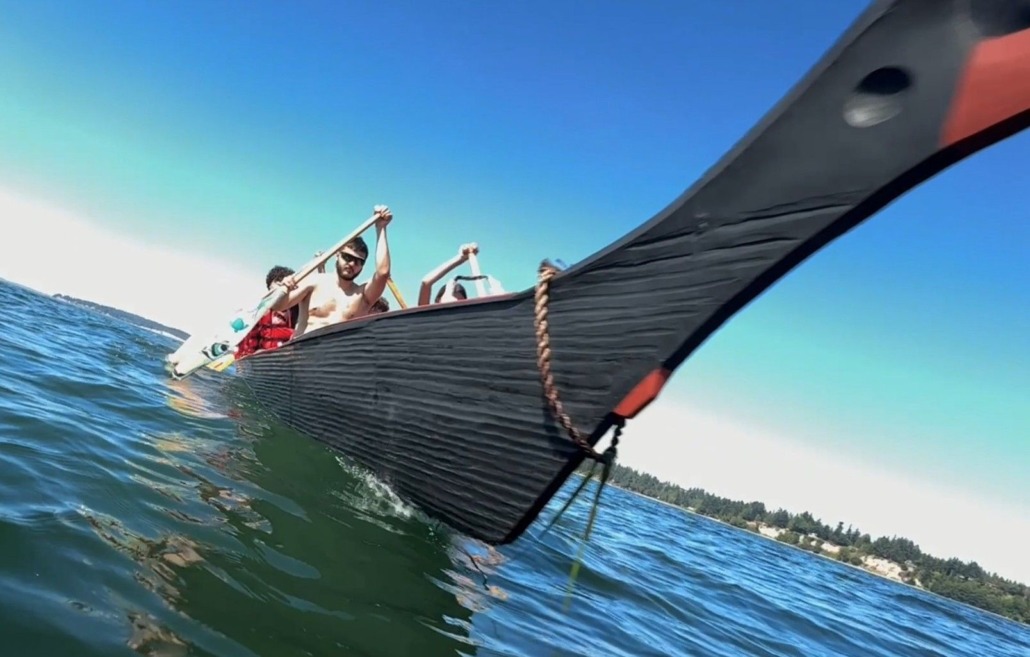
Paddles Up: Your guide to the people, traditions, and protocols of Tribal Canoe Journey
Tribal Canoe Journey brings thousands of people together on the water and ashore, each playing a part in carrying the Journey forward. For those experiencing it for the first time — or looking for a refresher — here’s what to know about canoe families, host communities, landings and protocol.
What is the Tribal Canoe Journey?
Tribal Journey is an annual event where canoes from across the region and beyond come together to share their cultures on the water and ashore. Tribes travel between communities until they reach the final host tribe. Once all the canoe families arrive at the final destination, tribal members engage in culturally rich activities, including protocol ceremonies where stories, songs, and gifts are shared. The hosting activities last for several days.
What is a canoe family?
A group of people who travel together via canoe, support boat, and/or ground support team. Some are tribal canoes, others are family canoes and some are intertribal canoes. They include community members of all ages.
Who participates?
Canoes have provided transportation for many Indigenous communities around the world. The Tribal Canoe Journey takes place annually across inland seas of the Coast Salish territories, and often reaches into the Northern Coastal regions, including tribal communities in Alaska and British Columbia, as well as along the coasts of Washington and California. Canoe families from as far as New Zealand and Hawaii have also joined in.
What are the responsibilities of host tribes?
As canoes travel to their final destination, they stop along the way to rest and recharge. Typically, host tribes along the route provide camping facilities and meals, as well as activities for the participants to come together and share.
As the journey progresses, more and more canoe families join in.
Support Boats
It is common for canoes to be on the water for 6-8 hours a day, or even more. They can range from simple fishing or sail boats to bigger vessels, but all support boats share one thing in common: they are always appreciated. Pulling alongside a support boat every few hours to switch out weary pullers, refill water bottles, take bathroom breaks, or grab a bite to eat is almost always a welcome break.
Landings
Once they’ve landed at their final destination, the event continues with shared meals and protocol ceremonies.
What’s happening when canoes come ashore?
Canoes will place “paddles up” as they approach the shore as a sign they are coming in peace, followed by someone from their canoe formally asking permission to come to shore.
A member of the hosting tribe – often Tribal Council members, youth royalty, and Elders – will grant the canoe permission to come ashore.
The canoe then will pull back out, circle around and come in backwards, as another sign of coming peacefully.
Here in Suquamish, canoes are then carried up our boat ramp and onto the lawn in front of the House of Awakened Culture. This is hard work and can be dangerous. Please stay out of the way.
In some locations, particularly when arriving to the final host of that year’s journey, canoes will request to come ashore in a specific order based on the distance from the hosting community.
Can I take photos? What about drones?
Feel free to photograph and video arriving canoe families and protocol ceremonies, unless an announcement is made to refrain from photography. When photographing individuals or specific items of regalia, it’s always polite to ask permission first.
Flying drones of any kind is not permitted in Suquamish during our hosting without specific permission from Suquamish Tribal Council or their designated representatives.
The Water Road to 2029
Suquamish set to host 40th anniversary of modern Tribal Canoe Journey
Four decades after Suquamish helped launch the modern Tribal Canoe Journey movement, canoes from across the region will once again come ashore here for a historic anniversary gathering.
The Suquamish Tribe committed in 2025 to host the 2029 Tribal Canoe Journey, marking 40 years since the 1989 Paddle to Seattle. Suquamish was the launching point for that first journey, which helped launch a revival of canoe culture and inspired the annual gatherings that now connect Indigenous nations throughout the Pacific Northwest, British Columbia and Alaska.
For Suquamish Tribe’s Cultural Resources Director Kate Ahvakana, the anniversary is about much more than a chance to commemorate a single event. It is an opportunity to honor the cultural resurgence that Tribal Journeys have helped carry forward from one generation to the next.
“The Tribal Canoe Journeys and the canoes themselves have brought back so many traditions and cultural teachings to us and to many different communities, wide and far,” Ahvakana said. “We want to honor those teachings and those cultural knowledge systems that have been building — food sovereignty, traditional weaving, our language, our practices on the water and our potlatch practices.”
A growing wave
She described that resurgence as a growing wave that continues to carry more and more renewed teaching and cultural strengthening.
“One thing is always connected to another, “she said. “It uplifts our community. It helps our community do things culturally and traditionally.”
Suquamish hosted the 20th anniversary Canoe Journey in 2009, welcoming about 6,000 guests as more than 80 canoes landed on Suquamish shores. The tribe built the House of Awakened Culture in preparation for that gathering, creating a cultural home modeled after Chief Seattle’s longhouse that once stood a short walk down the beach.
In the years since, the House of Awakened Culture has become a place for songs, ceremonies, weddings, funerals, celebrations and community gatherings — an enduring legacy of hosting.
“That was because we hosted Tribal Journey,” Ahvakana said. “So, we’re really looking forward to hosting again to create something that is going to benefit our community in similar ways. Our community will be enriched by this.”
Planning already underway
Indeed, planning for 2029 is already beginning, though the work will become more visible later this year. Ahvakana said community meetings and other opportunities to participate are expected to begin toward the end of 2026 as preparations grow.
Some hands-on work, however, is already underway. Tribal Elder Patty Medina has already been seen hard at work in her commitment to make 1,000 necklaces for giveaway items in 2029.
Meanwhile, the journey will continue across ancestral water highways over the next two years. The tribal community in Ketchikan, Alaska, is scheduled to host next summer in what promises to be an epic journey for participating canoe families. In 2028, the We Wai Kai and Wei Wai Kum First Nations in Campbell River, British Columbia are set to host.
But first this year’s Paddle to Medicine Creek Potlach will conclude with the Nisqually Tribe, where gathering canoe families will honor Billy Frank Jr., the Medicine Creek Treaty, and the long struggle to uphold treaty fishing rights. Ahvakana said visiting Nisqually brings renewed attention to sovereignty, salmon habitat, and the legal battles that continue to protect tribal fisheries.
Looking ahead to 2029, Ahvakana said the anniversary carries a powerful reminder of how far the movement has come.
“Since the revitalization of the Tribal Canoe Journey, our children will never know life without canoes and culture,” she said. “We have children now who have never known a different way. And that’s beautiful.”

