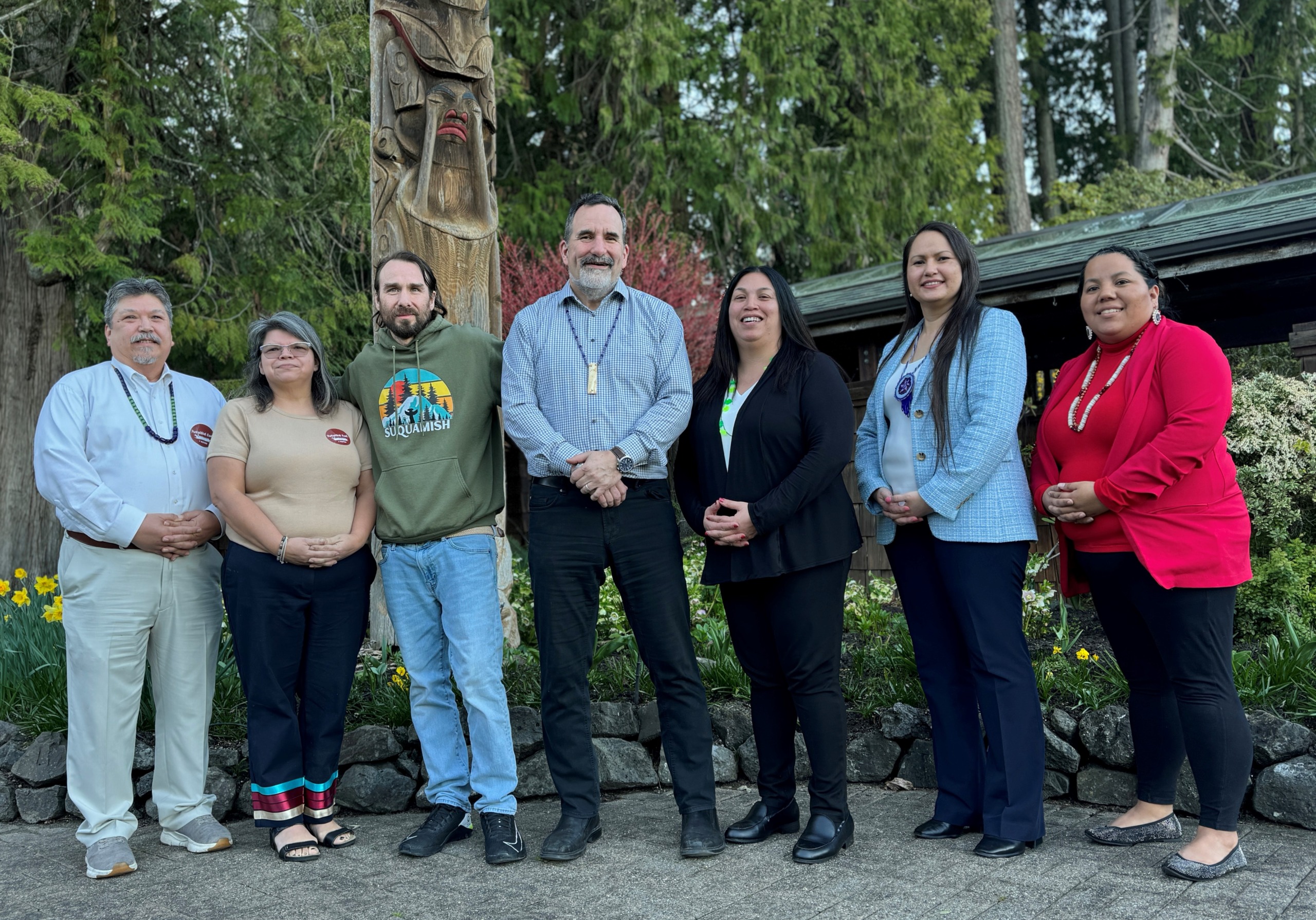
 Suquamish Tribal Council, from left to right, is Council Member Luther “Jay” Mills, Jr, Council Member Azure Boure, Vice Chair Josh Bagley, Chairman Leonard Forsman, Secretary Irene Carper, Council Member Lorilee Morsette, and Treasurer Denita Holmes.
By Suquamish Tribal Council
The Suquamish Tribe, like other first peoples of this continent, has experienced disruption since first contact with Europeans. We’ve survived disease, attempts to assimilate us by erasing our culture, and efforts to terminate us and attack our right to exist as a self-governing sovereign nation. But our ancestors were strong, and for generations we adapted and survived by relying on our culture, families, and our unity as a tribe.
Just as our past generations demonstrated, we will endure as a nation regardless of who holds federal office.
We will fiercely defend our access to health care, education, a strong economy, ecosystem health, and our right to self-governance. We will reject discrimination and racism. Our values, along with the enduring guarantees contained in our treaties and in the Constitution of the United States, form a strong foundation for the years and decades to come.
Here in Washington state, we have built strong collaborations with state leaders. The Centennial Accord created a protocol for frank and respectful government-to-government consultations, and we have made significant progress, especially in recent years with the leadership of Gov. Jay Inslee. We look forward to continuing this progress with Governor-elect Bob Ferguson and Attorney General-elect Nick Brown. With the election of the state’s new Commissioner of Public Lands, Dave Upthegrove, we anticipate continuing to cooperate on protecting forests, streams, marine ecosystems, and other treaty-protected resources here in Washington state.
We are delighted that state Senator Emily Randall will represent our district in the U.S. Congress. Her skillful bipartisan leadership at the state Legislature will be much needed in today’s polarized climate.
A bright spot in this election is the defeat of Initiative 2117, which means the Climate Commitment Act (CCA) will remain in force. This Act is strengthening our state’s economy while meeting ambitious climate goals. In Indian country, the CCA is funding restoration of fish and marine habitats, efficient and affordable heating and cooling systems in tribal homes, solar installations, and electrification of transportation.
In the next four years, we expect federal support for climate action to erode in the new administration, but here in Washington state, we can continue moving ahead, demonstrating to the nation that prosperity and responsible climate action go hand in hand.
In other respects, too, Washington state has become a model for positive tribal-state relations, and the outcome of this collaboration has benefited all state residents. Achieving this was not easy. But the enduring relationships we built with state and local officials will serve us all well during the years to come and could serve as a model for other states and for the nation as a whole.
We are grateful to President Biden who remained a true friend to Indian Country through his appointments at the Department of Interior and BIA, his investments in tribal governments and economies, and his protection of sacred sites. And we applaud Vice President Harris’ courageous run for the presidency. Their leadership and vision will not soon be forgotten.
We hope to have a positive relationship with the incoming president, and to continue the progress made under various administrations to fully recognize Indian people as the first Americans. Our differences aren’t as great as some people think. One of the Supreme Court’s most brilliant leaders on Indian law, Justice Neil Gorsuch, for example, was appointed during the first term of President-elect Trump. We have friends and supporters in both political parties, and we will continue building on the positive relationships we have developed over the years.
Regardless of who holds the highest offices in the land, this is clear: We will exercise the legal and cultural and spiritual rights that were passed down by our ancestors, and we will fiercely defend them for future generations.

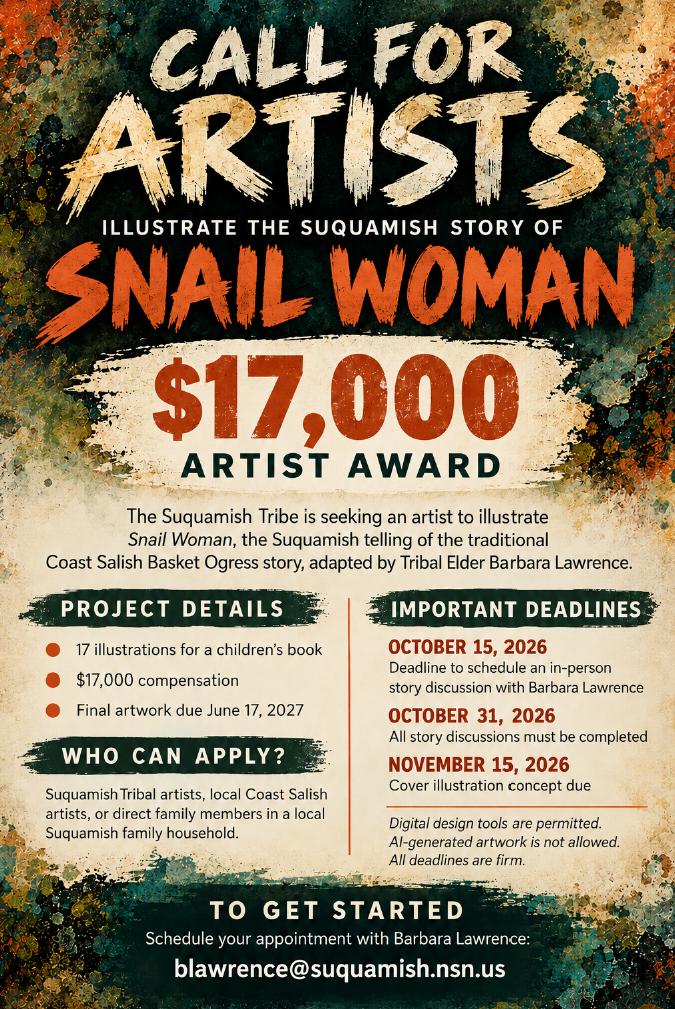 The story of Snail Woman, the Suquamish version of the Basket Ogress, will be the second in a four-part children’s book series — and an artist is needed to help bring it to the page.