Making Waves at CKA

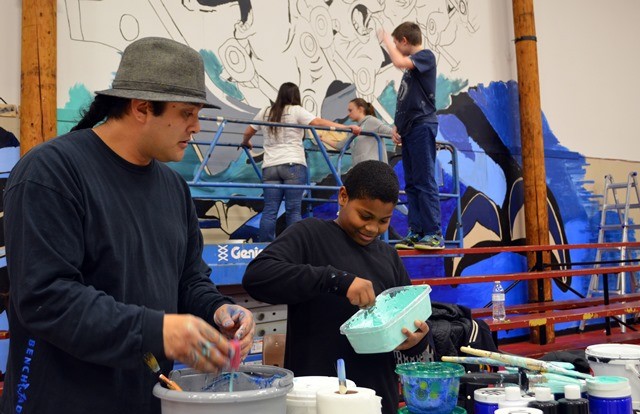
Mural artist Toma Villa, right, assisting students painting the new mural at Chief Kitsap Academy

Mural artist Toma Villa, right, assisting students painting the new mural at Chief Kitsap Academy

Oregon artist and Yakama Tribal Member Toma Villa has a unique approach to creating murals in Tribal Schools. He incorporates student learning into the process by working directly with Tribal youth to create the artwork. Work on the Chief Kitsap Academy Mural (CKA) began in January when Villa visited with students in a classroom setting. He spoke with them about art and later learned what images and shapes were important to them during a sketching workshop. The artist also met with family and community members during his initial visit, learning as much as he could about the Tribe and the school. Villa says inspiration for his initial sketch of the mural included stories he heard about orca visiting Suquamish Tribe journey participants in recent years. Salish designs and the CKA school mascot were also incorporated in the piece as a result of student sketches. In February, Villa returned to Suquamish with a complete rendering, and worked with students to create the 30-foot by 30- foot mural that now calls the CKA Gym home. CKA students and community members assisted Villa with the outline and fill to complete the mural in just 5 days. “It’s amazing, the students, staff and families are just thrilled with it,” said CKA Principal Fabian Castilleja. The CKA Mural Project was funded by the Suquamish Tribe Sports and Recreation Department, and spearheaded by Program Manager Kate Ahvakana. A time lapse video of the project is available on the Suquamish Tribe Facebook page at facebook.com/ suquamishtribe. More infomration about Toma Villa’s artwork, including murals, can be found online at tomavilla.com

Culvert Removal on Chico Creek

Ostrom Chico Creek

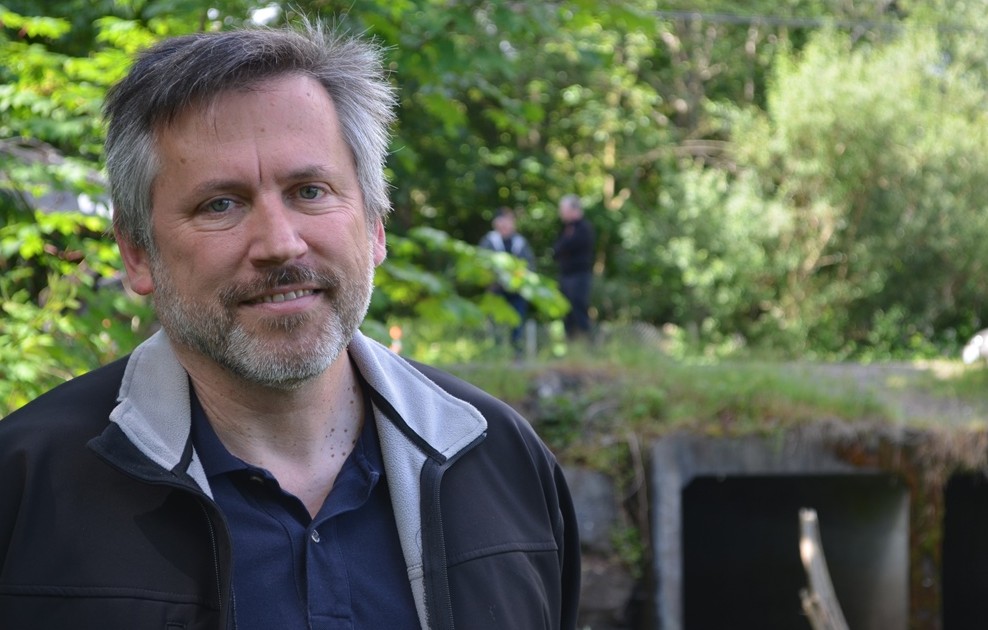
Tom Ostrom was the lead on the project for the Suquamish Tribe. He is pictured here, in front of the culvert, before its’ removal last summer.

Kitty Hawk Drive, just off Chico Way between Silverdale and Bremerton, WA was filled with work trucks and men in hard hats last summer. The relatively small, inconspicuous roadway was home to a stream culvert that was removed, thanks to the Suquamish Tribe’s cooperative efforts with local, state and federal officials.

Members of the Suquamish Tribe along with representatives from State, County and Federal regulatory agencies broke ground on the project on June 17, 2014.  Workers finished replacing the culvert with a bridge fall 2014, just in time for the early winter salmon runs in October and November.

Culverts are large cement tunnels that carry streams under roadways. The structures, used throughout the northwest during the last half of the twentieth century, create significantly faster running waterways that impede fish passage and damage creek beds.

Over the past several years the Suquamish Tribe has worked with government agencies and other organizations to remove the 40-foot culvert at Kitty Hawk Drive. The goal is to remove the even larger 400-foot culvert upstream under State Route 3 as well, resulting in a much healthier estuary at the mouth of Chico Creek.

Tom Ostrom, Salmon Recovery Coordinator in the Fisheries Department at the Suquamish Tribe, has been the lead on the project.

“The Washington State Department of Transportation has ranked the State Route 3 culvert as the second highest priority for replacement in the entire Olympia Region. Removing Kitty Hawk Drive from the historic Chico estuary is a necessary first step allowing for the future replacement of the State Route 3 culvert,” said Ostrom.
The Chico estuary is a diverse mix of habitats including stream and nearshore riparian, salt marsh, tidal distributary channels, and inter-tidal gravel beach. The Suquamish Tribe has documented juveniles of 5 species of Pacific salmon (including listed Chinook salmon and steelhead) rearing within the Chico estuary. In the early 1960s, the State Highway Department built State Route 3 and Kitty Hawk Drive on fill as deep as 50 feet, resulting in the loss of approximately 5 acres of channel, floodplain, and saltmarsh in the Chico Estuary.

Naloxone Saves Lives

Narcan

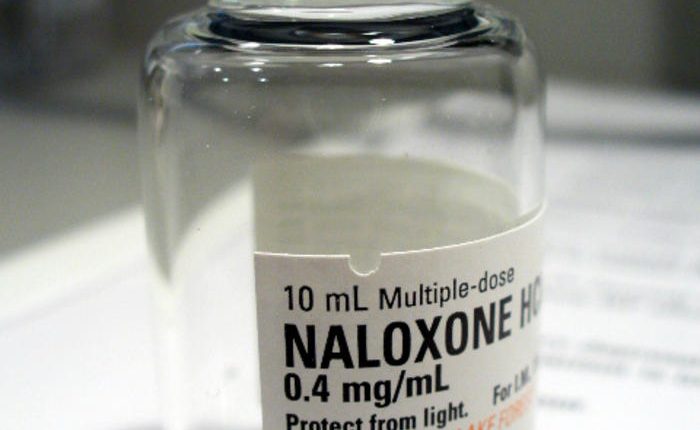
Naloxone, also known as Narcan, can save the life of a person who has overdosed on heroin.

Opioid overdose has become a leading cause of accidental death in Washington State.  Prescription opioid involved overdose deaths increased from 0.4 per 100,000 in 1995 to 7.4 per 100,000 in 2008. The rate dropped to 6.0 per 100,000 in 2010. The three opioids most often involved in overdose deaths are methadone, oxycodone and hydrocodone. Methadone has been involved in the majority of the deaths. States with higher sales of prescription opioids have higher rates of overdose deaths.  Fatal and nonfatal overdose can result from the ingestion of opioids such as morphine, methadone, heroin, fentanyl, oxycodone as found in OxyContin®, Percocet® and Percodan®, and hydrocodone as found in Vicodin®.  Heroin in Washington State varies in purity from 3.5% to 55% active ingredients; the users have no way of knowing the source or purity of the drug from one purchase to the next.

Naloxone, commonly known by the brand-name Narcan®, is an opioid antagonist which displaces the opioid from receptors in the brain and can therefore reverse an opioid overdose.  It is not a scheduled drug and it has no euphoric properties and minimal side effects. If it is administered to a person who is not suffering an opioid overdose, it will do no harm.  Naloxone has been available as an injectable since the 1960s, but was recently developed as a nasal spray.

To reduce the number of fatalities which can result from opioid overdoses, the Suquamish Police Department will train its officers in the proper first responder administration of nasal naloxone.  (No needles, just a nasal spray, kind of like afrin or other nasal medications)  In order to implement a safe and responsible nasal naloxone plan, the Department will establish and maintain a professional affiliation with a Medical Physician who will provide medical oversight for Departmental training and policy relating to the use of nasal naloxone. The Medical Physician shall be licensed to practice medicine within Washington State. At his or her discretion, he or she may make recommendations regarding the policy, oversight, and administration of the nasal naloxone program developed and implemented by the Department.

Our preference when someone is experiencing an overdose is to secure the scene, get the medics in there and transport the person to a hospital.  Sometimes, people use heroin or other opioids in rural or “out of the way places” to avoid detection, making it hard for a large fire truck to reach them.  In some cases the scene is dangerous, and the fire department won’t respond until those dangers have been dealt with.  Nasal Naloxone will buy time for the person until we can get them the help they need.  It also makes it easier on the officers; if you’ve ever performed CPR for a length of time, it can be exhausting work.  Naloxone allows us to quickly assist a patient in extreme distress, and restore the vital functions of their body until they can get advanced help.

Some people worry that having access to these emergency antidotes encourages drug use.  Research studies have investigated this common concern and found that making naloxone available does not encourage people to use opiates more.  The goal of distributing naloxone and educating people about how to prevent, recognize and intervene in overdoses is to prevent deaths.  Other goals, such as decreasing drug use, can only be accomplished if the user is alive.  As Law Enforcement, we’re in the life saving business.  A person can’t go to treatment if they die from a drug overdose.

Other people are afraid that if they call 911 to report someone overdosing, they’ll get in trouble.  While each situation is different, I can assure you that you’re far more likely to get in trouble if you don’t call 911, and someone dies.  Washington State has even passed a law to assure people wouldn’t get in trouble for calling 911 to get someone help; here is the link:  http://apps.leg.wa.gov/RCW/default.aspx?cite=69.50.315

The Tribe is still considering its full spectrum of options regarding how to deal with all of the legal and social issues involved, but the common practice of the Suquamish Police is to not target people who make a call that saves a life.  Making the call won’t forgive every illegal thing you’ve ever done, but we’ll give you quite a bit of consideration for doing the right thing.

If you’d like more information on these topics, a good resource is www.stopoverdose.org

Spotlight on PME’s Jay Mills

Spotlight on PME is a monthly article featuring employees of Port Madison Enterprises who have proven to be key to the success of Suquamish businesses. This month, Kiana Lodge Manager Luther “Jay” Mills talks about his experiences and the changes he has seen in nearly four decades working for the Suquamish Tribe.

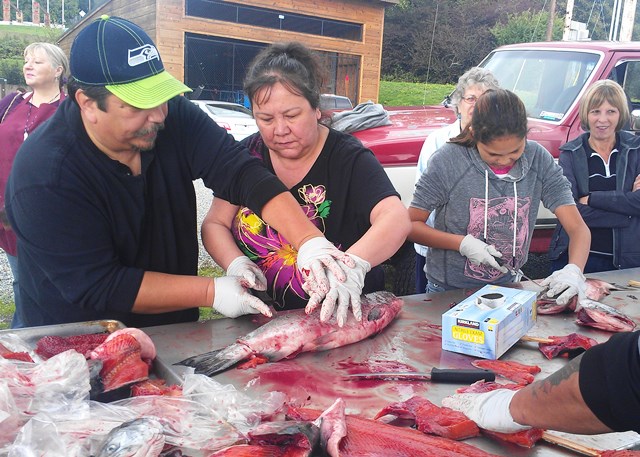
Luther "Jay" Mills Jr teaching a salmon filleting class during a traditional foods workshop in Suquamish.

Luther “Jay” Mills Jr teaching a salmon filleting class during a traditional foods workshop in Suquamish.

After 38 years of professional experience with the Suquamish Tribe, Jay Mills couldn’t be happier with the tribe’s growth. Right out of high school Jay had the opportunity for his first job as Night Watchman at the Smoke Shop, the tribe’s first business venture. Just two years later Frieda Scott and Lawrence Webster gave Jay the opportunity to be the Smoke Shop Manager. In 1981 the Smoke Shop was turned into the Liquor store making Jay the Liquor Store Manager. After 15 years of devotion to that position, Jay took the opportunity to become the Bingo Hall Assistant Manager in 1994. Jay later became the Bingo Hall Manager for three years before moving on to Slot Manager at the Clearwater Casino. In the six years as Slot Manager, Jay found independent contractor, Brent Brown, as a mentor to teach him everything he needed to know about the gaming world. As much as Jay enjoyed gaming he accepted the position as Kiana Lodge Director when the Lodge was purchased by the Tribe in 2004. In the last 11 years, Jay has enjoyed the Award Winning Kiana Lodge and looks forward to many years to come.

“My motivation and devotion to my career and family couldn’t have been possible without the support of my parents Delores and Luther Mills. They taught me about hard work, helping others and having respect for those around me. I also couldn’t be the person I am today without my wife of 37 years, Joanie Mills and our five children and 15 grandchildren. When it comes to a professional career I find it most important to thank anyone who has ever worked with me. Without those who worked hard and went above and beyond- I couldn’t have had the successful career I’ve had without them. Thank you everyone for your hard work,” said Jay.

Jay has had the honor of serving on the Suquamish Tribal Council for over 20 years, 2 as Tribal Vice Chairman and the other 18 as a Council Member, Jay was selected as Indian Gaming Magazines “Extraordinary Employee” September of 2004. An additional accomplishment that reflects on the hard work of Jay and his staff at Kiana Lodge, it was voted the Best NW Wedding Venue in both The Knot and South Sound Magazines in 2013. Kiana Lodge also won the Couples Choice Award for Demonstrating Excellence in Quality, Service, Responsiveness and Professionalism in 2015 on WeddingWire.com.

Jay is a current Tribal Council member, a former Leadership Kitsap Board member, is currently sitting on the Suquamish Seafood Board and the Suquamish Foundation Board. In his spare time finds joy in being a Suquamish Tribal commercial fisherman as well.

The future of the Suquamish Tribe has been bright from the moment Jay stepped out of high school. Watching the growth of the tribe in the last 38 years has made Jay proud to be a tribal member.

The opportunities within the tribe are endless, with the multitude of job and education opportunities; Jay understands the importance of the tribal youth for our future. “To all tribal members, seize the opportunity for a higher education and job opportunities that will get you your dreams. I started as a night watchman and am now the Director of Kiana Lodge. Hard work and motivation are key to obtaining your dreams; don’t be afraid to ask for help, as you never know who is willing to support you along the way.”