

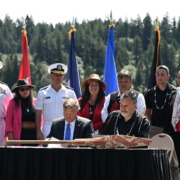
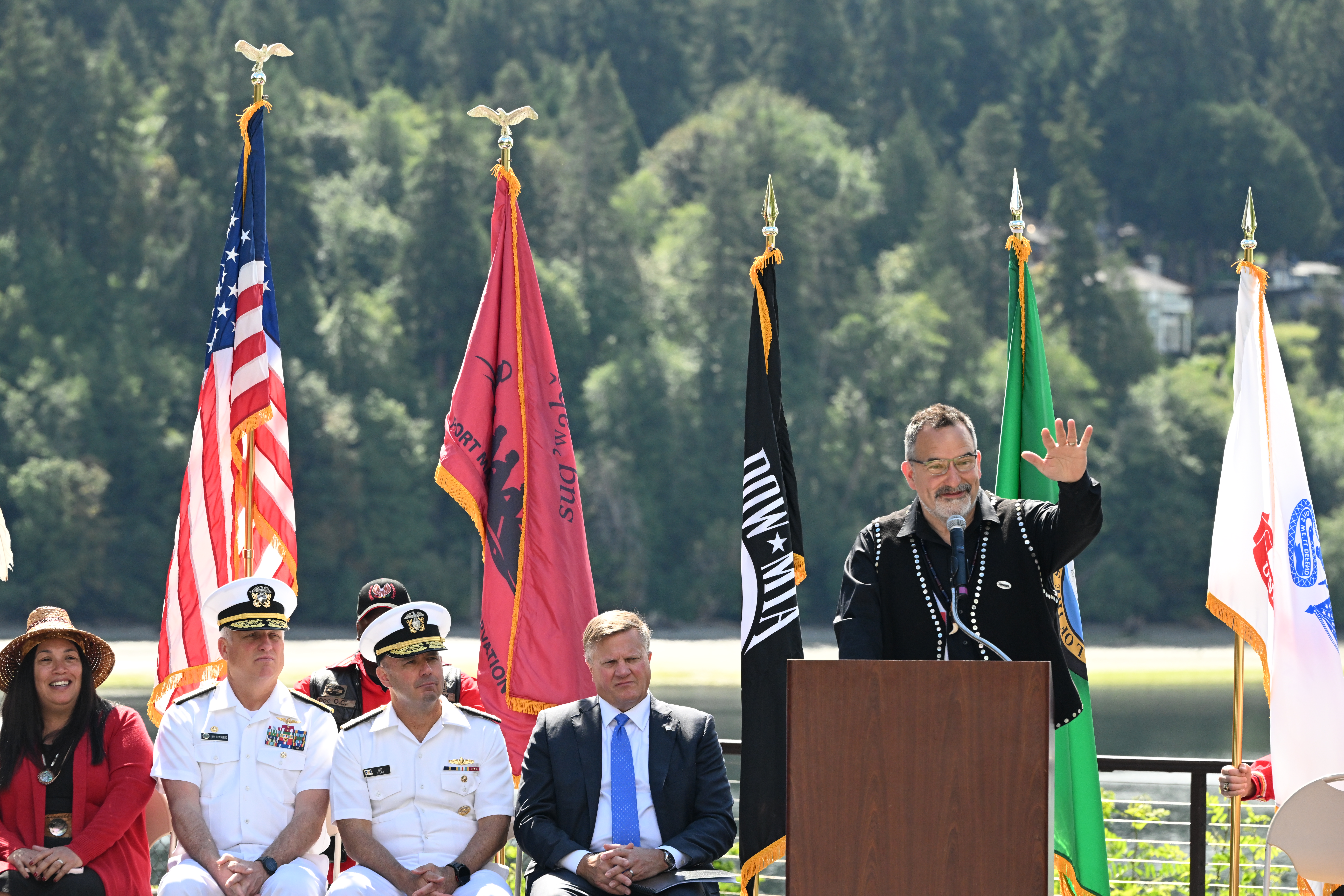
On Saturday, June 26, 2026, the Suquamish Tribe and the United States Navy commemorated the signing of a historic agreement that recognizes and addresses impacts to the Tribe’s treaty-reserved fishing rights in Sinclair Inlet resulting from a major naval construction project at Naval Base Kitsap-Bremerton.
The agreement follows years of extensive government-to-government consultation and good-faith negotiations regarding the Navy’s planned 12-year modernization project at Puget Sound Naval Shipyard & Intermediate Maintenance Facility (PSNS & IMF). The project includes the construction of new dry dock infrastructure to accommodate larger aircraft carriers and critical seismic upgrades throughout the facility.
Construction activities associated with the project will significantly impact the Tribe’s access to treaty-reserved fishing grounds in Sinclair Inlet, with portions of the area becoming inaccessible during the construction period.
To address these impacts, the U.S. Navy agreed to a comprehensive mitigation package recognizing the effects of the project on the Tribe, its members, treaty-reserved rights, trust resources, and cultural practices.
“The Suquamish Tribe is honored to host the United States Navy and Assistant Secretary Brendan Rogers to acknowledge this historic agreement recognizing and mitigating impacts to the Tribe’s treaty-reserved rights resulting from the Navy’s drydock construction project. Reaching this agreement has been a long and challenging journey for the Suquamish Tribe. Since the establishment of the Puget Sound Naval Shipyard in 1891, naval activities have impacted our people, our lands, and our waters. For generations, those impacts were often overlooked and inadequately addressed. This agreement reflects years of government-to-government engagement, relationship-building, and hard work by both the Navy and the Tribe,” said Suquamish Chairman Leonard Forsman.
Under the agreement, the U.S. Navy will provide the Suquamish Tribe with funding to compensate Tribal fishers and members for the loss of access to Sinclair Inlet for fishing and cultural purposes. In addition, the U.S. Navy will contribute funding for infrastructure, operations, and educational program improvements at the Gorst Creek Salmon Facility; support the construction of a shellfish hatchery; and assist the Tribe in reacquiring fractionated trust allotments at Doe-Keg-Wats, an ancestral village and site of profound cultural and ecological significance to the Suquamish people.
“This Memorandum of Agreement is a testament to what is possible when we lead with respect for sovereignty and mutual honor,” said the Honorable Brendan Rogers, Assistant Secretary of the Navy – Energy, Installations and Environment. “It addresses critical waterfront readiness needs, providing the essential infrastructure required to support our hardworking Sailors, Marines, and Department of the Navy civilians. The trust we have built today is the true foundation of this partnership.”
“We recognize and celebrate our collective work and willingness to engage in this Memorandum of Agreement to support both the United States Navy and the Suquamish Tribe,” said Admiral James Kilby, Vice Chief of Naval Operations. “I’d like to thank Chairman Forsman and the Tribal Council for their continued partnership. Without our shipyards, our Navy cannot maintain its fleet, and without our fleet, the Navy cannot defend our homeland.”
“While this agreement cannot erase the injustices of the past, it marks the beginning of a new chapter in the relationship between the Navy and the Suquamish Tribe, one grounded in mutual respect, meaningful consultation, and a shared commitment to coexistence. It demonstrates that we can ensure the Navy’s vital mission to defend our nation and honor and uphold treaty rights for future generations,” said Chairman Forsman.
The Suquamish Tribal Council is seeking written comments on a proposed revision of Suquamish Tribal Code Title 14, Chapter 1, Fishing. Please submit written comments by July 10, 2026. The proposed changes may be found below, or you may contact the Office of the Tribal Attorney for a copy.
The amendment to Suquamish Tribal Code 14.1 specifies that, in the event a Suquamish citizen’s treaty privileges are suspended either by the Fisheries Director or the Tribal Council, the deadline to file an appeal is twenty days after the suspension decision.
Submit comments to:
Office of the Tribal Attorney
STC Chapter 14.1 Comments
P.O. Box 498
Suquamish, WA 98392
Or by email with the subject line “Chapter 14.1 Comments” to mmohan@suquamish.nsn.us.



The Language Program is looking for Art/Craft Leads. Two positions are open for Leads to help facilitate a 2-hour evening art/craft session in Lushootseed. Compensation is a $500 stipend. The session must be held before mid-June. If interested, please fill out this form by May 8: https://forms.gle/XEScWDxrbSPDEM2cA.
Staff stayed active with youth and adult basketball while continuing twice-weekly Elders fitness classes. Tuesday sessions for Elders focused on stretching, walking, and a variety of exercises, while Thursdays feature our weekly favorite, Elders Volleyball.
BASKETBALL SEASON KEEPS GYM HOPPING
Sports & Rec staff worked with youth of all ages during a fun and fast-paced basketball season, coaching about a dozen teams. The junior high girls league served double duty this winter, preparing players for their school basketball season. Their hard work paid off, with every participant making their school team.
Staff then moved into their busiest stretch, managing weekday and weekend games across two leagues. The Kitsap Peewee League included five teams: coed ages 5–6 (EE level), girls age 7 (E level), boys age 10 (C level), girls age 10 (C level), and boys age 13 (A level).
BIG WINS ACROSS THE BOARD
All peewee teams had strong seasons. From first-time players scoring their first baskets to returning athletes building new skills and sportsmanship, each team found success.
The E level girls finished with just three losses on the season, while all other teams advanced to the playoffs. The C boys and A boys each placed third in the county. The C girls advanced to the championship game, finishing second after a hard fought contest.
Four teams also competed in the Poulsbo Parks & Rec League, including 2nd–3rd grade boys and girls teams and 5th grade boys and girls teams. These groups focused on skill development and learning the game, with no playoffs or championships. All competed well and enjoyed their time on the court.
Several teams also participated in tournaments throughout the winter, including Girls 12U AAU, Boys 8th Grade AAU, and multiple tribal tournaments.
The winter season remains the busiest time of year, with practices and games five days a week, both at the Fitness Center and at gyms across Kitsap County.
Staff are proud of all youth who participated this season, from experienced players to those just learning the fundamentals of dribbling, passing, and shooting. Each athlete showed growth not only in basketball skills but also in teamwork.