Teaching Our Story
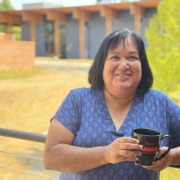
At tribal gatherings, meetings and community events, it is not unusual to find Suquamish Tribal Elder Barbara Lawrence with her hands occupied.
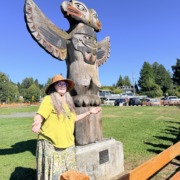
She might be listening to a speaker or visiting with someone while strips of cedar move through her fingers, gradually taking shape as one of the traditional Suquamish cedar hats she is known for weaving — intricate, beautiful and, importantly, made to be used.
Washington state educator Dr. Laura Lynn sees something of that same process in another of Lawrence’s creations, one that has taken years to bring together.
The Suquamish Tribe’s new Since Time Immemorial curriculum, Lynn says, is “a weave of so many of Barbara’s gifts: visionary, researcher, learner, sharer of historic knowledge, storyteller, passion, commitment, and generosity to support students and educators across our region.”
On Aug. 19, that long work reached a milestone as educators from school districts across Suquamish Tribe’s ancestral territory gathered at the Chief Kitsap Academy campus for the first professional development training on the tribe’s newly launched curriculum.
For Lawrence, the day was about much more than unveiling lesson plans. It was about relationship.
“Traditionally, when a big important thing happens,” Lawrence told the assembled educators. “We would send messengers out to go invite our neighbors and friends to come and witness the event.”
Those guests would be fed, given a place to rest and listen, entertained with songs and dances, and sent home with gifts.
“You’re witnessing that,” Lawrence said. “Cultural teachings on top of your academic teachings — and the cultural teachings are more important.”
Telling the Suquamish story
The curriculum gives middle and high school educators classroom-ready lessons developed specifically from a Suquamish perspective, including units on the Treaty of Point Elliott, treaty fishing rights, salmon habitat and the culvert case, housing, environmental issues, and contemporary tribal sovereignty.
The Treaty of Point Elliott unit provides the foundation for the others, beginning with Suquamish ancestral territory and place names and asks students to examine how maps themselves can convey different perspectives about land and ownership.
Later lessons move through the treaty and into contemporary questions — including how treaty fishing rights affirmed in the 1974 Boldt Decision eventually led to another landmark court fight over the state’s obligation to remove culverts that blocked salmon habitat.
The curriculum is designed to be interdisciplinary, connecting history and civics with science, ecology, geography and other subjects.
Chairman Leonard Forsman said its roots reach back decades.
After joining other tribal leaders concerned about low Native graduation rates, Forsman said a state study identified several underlying problems, including the absence of tribal history and culture in public-school curriculum.
That work helped lead to the state’s Since Time Immemorial Tribal Sovereignty Curriculum in 2005. But the state framework was always intended to lead educators toward the tribes whose lands their schools occupy.
The new curriculum allows Suquamish to tell that story directly.
“The more we learn about our first people the more it is good for everybody,” Forsman said. “It teaches us the real, true, factual history of the area.”
It also carries values that extend beyond a history classroom, he said.
“We want to take care of our elders. We want to look after our youth. We want to take care of the land, the water, and the air.”
Built by Suquamish
Creating the curriculum required years of research, writing and review involving Tribal Council and staff across tribal government, including Natural Resources, GIS, Housing, Education, and the Suquamish Museum.
The process was intentionally rigorous.
“Everything was cultivated with a keen eye,” Lawrence said. “If it wasn’t up to standard, for the elders of the tribe, for Tribal Council, for the teachers in the tribe, for administrators in the tribe, then it was reworked.”
In March, Tribal Council formally authorized the materials as the Suquamish Tribe’s Since Time Immemorial curriculum. The public rollout this summer also includes a new curriculum website embedded within the Education section of the Suquamish Tribe’s government website.
The site serves as the curriculum’s central hub, providing educators with lesson plans, teacher guides, presentations, maps, videos, historical documents and other resources. Middle and high school lessons are organized into units teachers can access directly from the site, along with supporting materials and a way to contact the tribe for assistance with the curriculum.
The site also opens with a new video welcome from Chairman Leonard Forsman, who introduces students and educators to the Suquamish people and their ancestral territory and explains the significance of the phrase “since time immemorial.”
“Our history did not begin with settlers,” Forsman tells students in the video. “It did not begin with a date in a textbook.”
Forsman traces the tribe’s connection to the lands and waters of the region back thousands of years, explains the continuing importance of the Treaty of Point Elliott and tribal sovereignty, and describes the cultural resurgence underway today — from Lushootseed language revitalization to carving, weaving, song, ceremony and the modern Tribal Canoe Journey.
He closes the video by asking students to consider themselves part of that continuing story, learning from the generations that came before while thinking about those still to come.
The rollout also introduces a new visual identity for the curriculum. Its logo, created by Lushootseed language teacher and tribal artist Joey Holmes, was selected from eight submissions by the tribe’s Cultural Co-op Committee. The central image draws from a photograph of Lawrence storytelling with children.
The website also incorporates the Unfolding Fern, a traditional basket design representing youth and learning that Suquamish Tribal Elder and artist Peg Dean originally created years ago as an emblem for the tribe’s emerging Education Department. The fern now appears throughout the curriculum site to identify materials developed and approved by the Suquamish Tribe.
“Everything has meaning,” Lawrence said. “They’re not just a design. They’re meaningful.”
At the Aug. 19 training, educators became the first outside group to work through the completed website and lessons.
Dr. Elise Washines, a Yakama educator who helped develop the curriculum, guided participants through the materials while emphasizing three concepts running through the work: relationship, respect, and reciprocity.
Washines contrasted those values with educational systems that can become focused primarily on evaluation — what students or teachers are doing wrong and what must improve next.
“There are ways to grow,” she said. “But before we even think about that, we have to think about all the moments that we appreciate, all the relationships that we’re building with each other.”
For Lynn, who previously helped oversee the statewide implementation of Since Time Immemorial through the Office of Superintendent of Public Instruction, that approach reflects Lawrence herself.
“Her tireless efforts to collaborate with districts and organizations establishes the foundation of positive relationships necessary to implement existing lesson resources and grow future learning,” Lynn said.
The curriculum, she added, stems from Lawrence’s “profound love of the Suquamish People, our lands, waters, and relatives of nature.”
From curriculum to classroom
Now comes the test Lawrence has been working toward for years: getting it used.
Seattle Public Schools is already preparing the Suquamish materials for its learning management system and incorporating them into the district’s required scope and sequence, said Shana Brown, a curriculum specialist with the district’s Native Education Program.
The district plans to use Suquamish curriculum during the second semester in seventh- and eighth-grade social studies and in high school U.S. history and civics courses.
“We got the support of principals so that principals can take that to their schools,” Brown said.
But making curriculum available and getting it into classrooms are two different things.
“Just getting the word out is a lot harder than you think it might be,” Brown said.
Educators at the training discussed ways to integrate the lessons across disciplines. One Chief Kitsap Academy teacher described connecting the curriculum with the school’s Ocean to Table program, where students fish for and process salmon.
Students could simultaneously learn the history behind what they are doing — from the Boldt Decision to treaty rights and salmon habitat restoration.
Other educators identified a need for help introducing tribal perspectives that may challenge what students — or teachers — previously understood.
That is where Lawrence says relationships remain essential.
Teachers should also be able to bring Suquamish cultural educators directly into their classrooms, she said — and schools need to recognize that expertise as professional work.
“School districts need to pay for cultural educators to come in, whether it’s storytellers or fishermen, or a clam digger — somebody cultural from the tribe to come and teach something,” Lawrence said. “It’s real work. It’s real, valuable work, and school districts need to plan for that.”
A living curriculum
The website currently includes two middle school units and three high school units, with the Treaty of Point Elliott serving as the prerequisite foundation. Elementary and early learning sections are planned as funding becomes available.
The work will continue to evolve.
“This is a living curriculum,” Lynn told educators. “So keep checking back in because we’re going to continue to refine and add resources.”
That includes videos, maps and other teaching tools as well as lessons connecting treaty history to issues unfolding today.
Acting Education Division Director and Chief Kitsap Academy Principal Lucy Dafoe said the launch is the beginning of an ongoing relationship with educators, not just a single training.
For now, Lawrence asked those attending the first training to make their own commitment.
“We’re saying, here we are,” Lawrence told them. “We’re helping you. We’re creating this and we have all these resources and we’ll help you. So please take informed action with us.”
The lesson of Young Crow
For all the years of research, legal review and curriculum development that brought the project to this point, Lawrence traces her own understanding of education much farther back.
Her first teachers, she says, were Suquamish Elders.
They gathered children to teach them everything from stories and songs to respect and responsibility — sometimes while taking them berry picking, clam digging, or cleaning at the cemetery.
As a child, Lawrence thought the stories told during those chores were entertainment.
Then one day, while the children were berry picking, her younger brother found a creative way to avoid working. Lawrence couldn’t help but notice that an Elder then soon told a story about Young Crow — who worked very hard at not working.
Something clicked.
“I suddenly realized this isn’t entertainment,” Lawrence recalled. “This is education.”
She began listening differently.
Decades later, that understanding is woven throughout a curriculum intended to reach thousands of students across Suquamish territory.
Like one of Lawrence’s cedar hats, the finished work is intricate because the knowledge behind it is interwoven from a history that stretches back thousands of years – literally, since time immemorial.
And it is also made to be used.
“Now the real work begins,” she said with a determined smile. “It’s time to get these lessons into the classrooms.”