Suquamish Tribe announces intent to sue U.S. Navy

The Suquamish Tribe announced its intention to sue the U.S. Navy for repeatedly releasing raw sewage into the Puget Sound.

In a letter dated June 10, the Tribe gives military officials 60-days’ notice of the Tribe’s intent to file a lawsuit under the Clean Water Act, which prohibits discharging pollutants without a permit.

According to public records currently available to the Tribe, the Navy discharged hundreds of thousands of gallons of untreated sewage from Naval Base Kitsap in repeated incidents over the past five years and beyond.

Some of these spills continued unchecked for weeks and even months. One lasted for more than four years. Some of these spills had been previously announced by the Navy. Others had not.

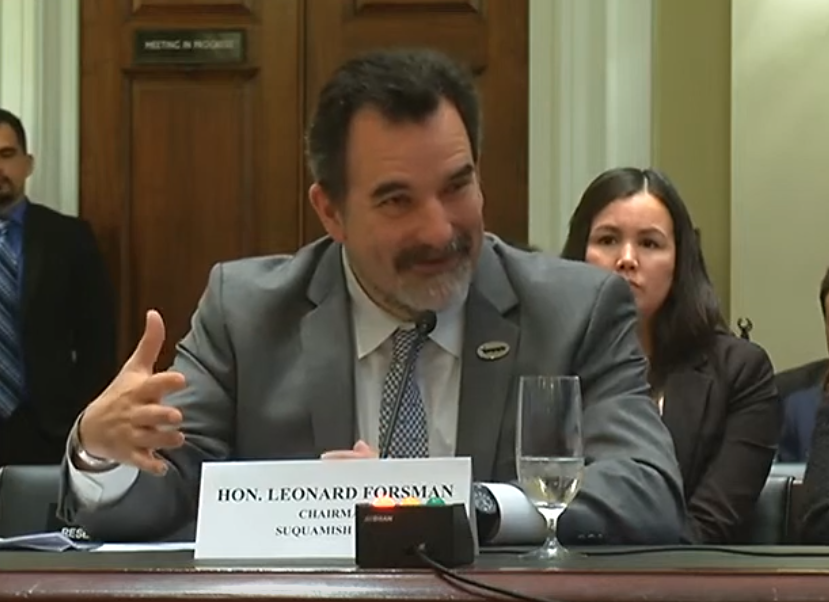
“The waters of the Sinclair Inlet and the entire Salish Sea are the Tribe’s most treasured resource. We are obliged to protect these waters, not only for us but for all who rely on them for work, recreation, and identity,” said Suquamish Tribe Chairman Leonard Forsman.

“We ask the Navy to uphold the highest standards of protection for Liberty Bay, Dyes Inlet, Sinclair Inlet, Port Orchard Passage, and all the water ways that support both human and marine life. We call on the Navy to invest in the infrastructure necessary to support their operations.”

The 60-day notice is addressed to Acting Defense Secretary Patrick Shanahan, Navy Secretary Richard Spencer, Naval Base Kitsap Commander Capt. Edward Schrader, and Puget Sound Naval Shipyard Commander Capt. Howard Markle.

“We value and respect the service of our local Sailors and Marines, and we treasure the relationship we enjoy with the wider U.S. Military and veteran communities,” said Forsman. “However, the dumping of sewage waste into Puget Sound must stop.”

The Tribe notified the Navy that it is responsible for at least eleven significant illegal discharges of untreated sewage into Tribe’s treaty-protected fishing areas, including several discharges that occurred over multiple weeks or years.

For example, Puget Sound Naval Shipyard illegally discharged 80,000 gallons of untreated sewage between July 30, 2018 and August 13, 2018 when a sanitary sewer line clogged and flowed into a stormwater line and then directly to Sinclair Inlet.
Another example: A sewer line leak caused about 1,500 gallons of untreated sewage to dump into Liberty Bay daily from around December 18, 2017 extending well into 2018.

“These discharges have resulted from long-standing, system-wide problems with aging infrastructure at these naval installations, improper and inadequate training, improper and inadequate maintenance, repair, and replacement of this infrastructure, and other reasons known to you,” states the Tribe in its letter to Navy officials.

The Suquamish Tribe – known as “The People of the Clear Salt Water” in their Southern Lushootseed language – have fished and gathered shellfish in and near Puget Sound from time immemorial. The waters around Naval Base Kitsap make up much of the Tribe’s treaty-protected fishing and shellfish harvesting areas.

The Navy’s ongoing sewage discharges often result in the posting of health advisories and the closure of beaches where Suquamish tribal members harvest shellfish. Some sewage spills have prompted recalls of commercially sold shellfish. Other spills have interfered with the harvest and sale of salmon.

“This lawsuit is not just about how these dangerous spills affect the Suquamish Tribe,” said Forsman. “The entire Puget Sound community deserves clean water. The shellfish, the orca, and all sea life rely on clean water, and all of our children – and children’s children – deserve clean water.”

“This is why the Clean Water Act was created. It’s time for the Navy to obey the law and start protecting our waters right here at home,” said Forsman.

Suquamish Tribe – A Learning Culture

Suquamish Tribe – A Healthy Culture

Saved By Salmon – Northwest Treaty Tribes

Suquamish Welcomes New CEO to Port Madison Enterprises

Longtime hospitality executive Sam Askew returns to Port Madison Enterprises

The Suquamish Tribe’s waterfront Clearwater Casino Resort is the flagship venture of Port Madison Enterprises.

SUQUAMISH, WA- February 2, 2018 The Suquamish Tribe is pleased to announce the selection of Samuel Askew as the new Chief Executive Officer of Port Madison Enterprises (PME).

“After an extensive search, we chose Samuel Askew for his experience and vision. We look forward to future growth and success with Samuel at the helm of our daily operations,” said Port Madison Enterprises Board President Greg George.

Askew brings nearly two decades of experience building and managing hospitality ventures in the Pacific Northwest to PME. He replaces retiring CEO Russell Steele, who spearheaded business operations at the Suquamish Tribe’s enterprises for 17 years.

“I want to congratulate Samuel Askew on his new role as head of PME, and thank the PME Board for their diligent efforts in making this important decision. Samuel is familiar with our Tribe, and we know he can help us grow our economic future in a diversified manner,” said Suquamish Tribal Chairman and Affiliated Tribes of Northwest Indian President Leonard Forsman.
Samuel Askew, new CEO of Port Madison Enterprises

The move to Suquamish is a homecoming for Askew. From 2006 to 2011 the hospitality veteran managed PME’s waterfront hotel, Clearwater Casino Resort, where he was named Washington State General Manager of the Year by the Washington Lodging Association and Innkeeper of the Year by the Kitsap Peninsula Visitor and Convention Bureau in 2010.

“I’m honored to have the opportunity to return to the area, and tribal community; leading teams of professionals throughout PME that I have a great respect and care for. It’s great to be home again!” said Askew.

For the past 7 years, Askew has managed operations at Tulalip Resort and Casino. He has also served as co-chair for Northwest Tribal Tourism and held executive positions at the Squaxin Island Tribe’s Little Creek Casino Resort, Alderbrook Resort and Spa, and Riverhouse Resort. Before beginning his career Askew studied Hotel and Restaurant Management at Northern Arizona University’s Hospitality School.

About Port Madison Enterprises
In 1987, the Suquamish Tribe established PME as an agency of the Suquamish Tribal Government. PME’s operations are aimed at developing community resources while promoting the economic and social welfare of the Suquamish Tribe through commercial activities. What began as a modest retail endeavor has grown exponentially over the last three decades.  PME now encompasses several businesses including Suquamish Clearwater Casino Resort, the historic Kiana Lodge, three retail outlets, White Horse Golf Course and a property management division. For more information about PME, visit them online at www.portmadisonenterprises.com

New Vendor Friendly Area to Replace Aging Building Along Suquamish Waterfront

The building, often referred to as the “Barnacle Building” will be demolished in late January, 2018.

Demolition of the waterfront building located at 18408 Angeline Avenue in Downtown Suquamish will begin later this month. Work to raze the aging structure, formerly home to Scratch Kitchen and Bella Luna restaurants, is scheduled to start on January 22, 2018 and is expected to take a week to complete. Port Madison Enterprises (PME) owns the property, and made the tough decision to remove the building after an assessment last year.

The side of the building faces a steep cliff on the waterfront in Downtown Suquamish. Though the building will be torn down, PME is taking steps to ensure the unique tree near the entrance remains on the property.

“The building’s location on the cliff, its’ age and condition were all factors in the decision. We just aren’t able to salvage the structure,” said PME Board of Directors Member Windy Anderson.

After demolition, PME plans to create a covered, open space area on the property to be used for multiple vendors, including those selling food items.

“Hopefully we will be able to utilize the space to provide the community with multiple food choices by late summer,” added Anderson.

Though the building is slated for demolition, the Suquamish Tribe Archaeology and Historic Preservation Program has been tasked with ensuring the history of the property is recorded. During the last 50 years, it’s been a restaurant, a coffee cantina, a head shop, an art studio, an apartment complex and a private residence. Property records indicate the building was constructed in 1948 and originally used as a hotel for travelers. However, there is some debate about whether the building was built on the property, or ferried over by barge from Seattle, WA.

An aerial photograph of the Suquamish Waterfront cir. 1930, detailing the location of the old Suquamish Ferry Dock and Ticket Booth, shows the undeveloped property where the building would later be located. Courtesy of the Suquamish Museum archives.

A photo of the Downtown Suquamish waterfront estimated to be taken in the 1950s’, where the building can be viewed next to the old Suquamish Ferry Dock.

“Unfortunately, this is an era where we don’t have a lot of information in our archives for those properties. During the early decades of the 1900s the federal government aggressively implemented assimilation policies, including land allotment policies that allowed reservation property to be sold out of Tribal member ownership.  BIA Agents used discriminatory regulations that declared Tribal Members non-competent giving them the access to sell lands, mostly large waterfront parcels like downtown Suquamish,” said Traditional Heritage Specialist Marilyn Jones.

An old advertisement that appeared in the Seattle Star, offering cheap land on the Port Madison Indian Reservation. For more information on the Allotment & Assimilation Era click here. For more information on the early 20th century history of the town of Suquamish click here.

Jones is seeking additional information about the building from the community and encourages the public to submit any photos or stories about the property to her office by contacting her at mjones@suquamish.nsn.us

PME’s purchase of the property, and several others in the downtown Suquamish area over the last decade, is part of the Suquamish Tribe’s “Buy Back the Reservation” initiative. With help from a combination of funds, including profits from Tribally-owned businesses, the Suquamish Tribe has been able to purchase individual properties back from private owners.

In 2015, the Reservation Buy Back Initiative reached a new milestone when the Tribe negotiated the purchase of a 220-acre parcel of land at the headwaters of Cowling Creek. The acquisition, coupled with properties owned by the Tribal Government and those owned by individual Tribal members, meant that the Suquamish owned more than half the properties within reservation boundaries for the first time in more than half a century. The Suquamish Tribal Government continues to make the initiative a priority and sets aside funds for purchases when available each year.

KCSO & Suquamish Police Interlocal Agreement

Kitsap County Sheriff Gary Simpson and Suquamish Police Chief Mike Lasnier are pleased to announce that Kitsap County and the Suquamish Tribe have entered into an agreement to provide better and more efficient police services on the Port Madison Reservation. Effective July 1, 2017, Suquamish Police Officers will have state authority to:

  •  issue state citations to non-Indians for state traffic violations on the reservation.
  • pursue non-tribal traffic law violators and fleeing suspects past reservation boundaries.
  • under certain circumstances, arrest non-Indians for state crimes committed on the reservation.

The agreement is part of a new Memorandum of Understanding (MOU) between the Suquamish Tribe and Kitsap County, and fulfills the conditions of a Washington State statute that, upon request, requires county governments to enter into agreements with tribes when they share jurisdiction on an Indian reservation (RCW 10.92). The KCSO and SPD have worked together to provide law enforcement services on the Port Madison reservation for many years. However, depending on the type of land ownership and the Indian status of individuals, the rules for jurisdiction changed for each agency.

KCSO Lt. Jeffrey Menge pointed out that prior to the MOU a tribal officer had (and still has) the right to detain any person suspected of a crime and could investigate any crime on the reservation but they could not make any formal arrests or transports under state law. This will now change. An example of this new collaboration can be illustrated with a common DUI Investigation. In the past, a tribal officer had the ability to stop and detain a person suspected of DUI on the reservation but once they determined the suspect was “non-Indian”, the officer was required to stop and wait for a KCSO Deputy or State Trooper to respond and finish the investigation. Under the MOU, the Suquamish officer can now complete the entire investigation under state authority, including arrest and transport to the jail, thus eliminating the need to tie up other officers and duplicate efforts.

The Suquamish Police Department includes a Marine Division, that also coordinates with Kitsap County Sheriff Deputies.

“It doesn’t take two cops to do the work of one cop. Tribal officers and citizens have been stuck on the side of the road awaiting the arrival of a Deputy, who in many cases was pulled away from a more serious investigation to come handle a minor offense. It gets worse; two officers now have to write reports, receive subpoenas and will have to go to court at substantial cost to two different governments. These are low level cases; traffic violations and misdemeanor property crimes. We want our deputies out there catching burglars and heroin dealers, not driving 20 minutes to write a suspended driver a citation we could have issued in 90 seconds,” said Suquamish Police Chief Mike Lasnier.

Sheriff Gary Simpson credits a good working relationship between Kitsap County and the Suquamish Tribe for making the MOU a reality. “Our already collaborative and cooperative working relationship made this process as easy as it could have been, given its complexity.” Simpson said, “In many ways, this agreement memorializes an already fantastic working relationship.”
Sheriff Simpson added that the end result of the complex process is “a more effective and efficient public safety response for all citizens on the Port Madison Reservation and surrounding communities.”

Kitsap County Sherriff will be hosting an open house for those who want to know more at 5:30 p.m. on June 22, 2017 at the Suquamish United Church of Christ, 18732 Division Ave. NE, Suquamish, WA 98392.  For more information on the interlocal agreement, check out our Suquamish Police Frequently Asked Questions Page or download a printable brochure by clicking here.

The Opioid Crisis Part 1: Your Medicine Cabinet

It is a common misconception that our community has drug dealers skulking about, offering heroin to passing school children in an attempt to get them hooked on opioids. The truth is far more mundane, and more dangerous.

Of people who start to use opioids, the majority start with prescription pills. The vast majority of our current heroin addicts became addicted when they were prescribed oxycontin by doctors in years past.  When oxycontin was suddenly restricted, a large number of people were left addicted, with no source of opioids other than inexpensive brown tar heroin.

Doctors are supposed to access a website, where they can review and confirm that their patients aren’t already receiving opioids from one or more other doctors.  Only 1 doctor in 3 uses that system, so 2/3 of the opioids being prescribed are being prescribed “blindly”.  Even this isn’t the source of opioids for most new users, though.

Some common prescription opioids are:

  • codeine (only available in generic form)
  • fentanyl (Actiq, Duragesic, Fentora)
  • hydrocodone (Hysingla ER, Zohydro ER)
  • hydrocodone/acetaminophen (Lorcet, Lortab, Norco, Vicodin)
  • hydromorphone (Dilaudid, Exalgo)
  • meperidine (Demerol)
  • methadone (Dolophine, Methadose)
  • morphine (Astramorph, Avinza, Kadian, MS Contin, Ora-Morph SR)
  • oxycodone (OxyContin, Oxecta, Roxicodone)
  • oxycodone and acetaminophen (Percocet, Endocet, Roxicet)
  • oxycodone and naloxone (Targiniq ER)

Who is the source?  Who is getting new users hooked on these opioids?  In most cases, it’s you…your family….and your friends.  It’s not some shady guy in an overcoat slinging drugs in a dark alley.  It’s your medicine cabinet.

According to the 2016 DEA Threat Assessment, “Recent Initiates” to opioids get their pills “obtained from friend/ relative for free or without asking” 66.2% of the time. They get them “prescribed from one or more doctors” 19.3% of the time. Folks…we’re at 85% already, and no drug dealers have been mentioned yet. The remainder is bought from friends and relatives, purchased off of the internet, and a tiny percentage purchased from people we would consider “drug dealers”. The drug dealers account for somewhere between 1-4% of the source.

This isn’t a “police” problem.  Just paying for cops and walking away isn’t a viable solution. If we arrested every drug dealer at the Reservation border before they could enter, we’d still have over 95% of the source of these opioids in place.

What about frequent, chronic pill users? They are still getting the pills from friends, family or doctors without cost nearly 70% of the time. They are purchasing them 24.5% of the time, but many of those purchases are from friends and relatives. The police can’t be in your living room every time the family comes over, and you don’t want us there.

Where do the family and friend get all of these opioids? In 83.8% of the cases, from one doctor, who is still following old, incompetent prescribing practices and is prescribing way too much medication when it’s no longer needed. In some cases, the doctor is the culprit; in many cases, it’s us!  We don’t use all of the medication, but we keep it in the house, waiting for someone to be tempted.

WHAT CAN WE DO ABOUT IT?

Get all of your unused pain pills out of your house. The Suquamish Police department is the only full time DEA “Drug Take Back” location in Kitsap County. We have taken over 400+ pounds of opioids off of the streets using this program. It’s easy; walk in, drop the pills bottles into the box. Walk away.  You don’t even have to talk to anyone. It’s the big green metal box.  We clear out the contents and ship them to the DEA for incineration. No cost, no forms, no hassle.

If an elderly or disabled family member is hospitalized, moves to a nursing home, or passes away it is critical to get their prescription pills collected and dropped in a drop box for destruction.

If you have young people in your life, and they get a sports injury, or have a minor surgery, do NOT let them be prescribed opioids.  Recent studies show that any use of opioids prior to the age of 18 leads to a 30% increased chance of opioid addiction as an adult.

What about overdoses? Heroin is far more dangerous than prescription pills, right?  This answer is, historically, no. Prescription opioids have killed dramatically more users than heroin. Even today, with the extremely dangerous fentanyl laced heroin, prescription opioids are still killing more people here in Washington State. Of all opioid overdoses, prescription opioids are killing users roughly 60% of the time, with heroin killing the other 40%.

If you or someone you know needs to use opioids, ask for a prescription of nasal naloxone at the same time, so you have the antidote to go with the medication, in the event of an overdose. Tell everyone in your household where the Naloxone is kept.

Chief Lasnier is Vice Chair of the Opioid Steering Committee for Clallam/ Jefferson/ Kitsap Counties, working cooperatively as a team with doctors, treatment providers, mental health workers, police, prosecutors, courts, emergency medical staff and responders and others to find solutions to this opioid challenge. It’s going to take all of us, and more importantly it’s going to take all of you!

IF YOU ENCOUNTER SOMEONE WHO MAY BE EXPERIENCING AN OVERDOSE:

Check for signs of overdose:

  • Won’t wake up. Try rubbing your knuckles hard on their sternum. (Bony center chest)
  • Slow or no breathing, shallow ragged breaths, strange snoring noises.
  • Pale, ashy, cool skin
  • Blue lips or fingernails

Call 911. Tell the dispatcher where you are and that someone is not breathing or is unconscious.

If you are trying to help in an overdose, WA State’s 911 Good Samaritan/Overdose Law protects both you and the overdose victim from drug possession charges.

Don’t be afraid to call 911 for help!

If you are trained in 1st Aid or CPR, proceed as you were trained.  If not, the 911 operator will help you until assistance arrives.

Next time: The Opioid Crisis Part 2: Heroin