Suquamish Tribe announces intent to sue U.S. Navy

The Suquamish Tribe announced its intention to sue the U.S. Navy for repeatedly releasing raw sewage into the Puget Sound.

In a letter dated June 10, the Tribe gives military officials 60-days’ notice of the Tribe’s intent to file a lawsuit under the Clean Water Act, which prohibits discharging pollutants without a permit.

According to public records currently available to the Tribe, the Navy discharged hundreds of thousands of gallons of untreated sewage from Naval Base Kitsap in repeated incidents over the past five years and beyond.

Some of these spills continued unchecked for weeks and even months. One lasted for more than four years. Some of these spills had been previously announced by the Navy. Others had not.

“The waters of the Sinclair Inlet and the entire Salish Sea are the Tribe’s most treasured resource. We are obliged to protect these waters, not only for us but for all who rely on them for work, recreation, and identity,” said Suquamish Tribe Chairman Leonard Forsman.

“We ask the Navy to uphold the highest standards of protection for Liberty Bay, Dyes Inlet, Sinclair Inlet, Port Orchard Passage, and all the water ways that support both human and marine life. We call on the Navy to invest in the infrastructure necessary to support their operations.”

The 60-day notice is addressed to Acting Defense Secretary Patrick Shanahan, Navy Secretary Richard Spencer, Naval Base Kitsap Commander Capt. Edward Schrader, and Puget Sound Naval Shipyard Commander Capt. Howard Markle.

“We value and respect the service of our local Sailors and Marines, and we treasure the relationship we enjoy with the wider U.S. Military and veteran communities,” said Forsman. “However, the dumping of sewage waste into Puget Sound must stop.”

The Tribe notified the Navy that it is responsible for at least eleven significant illegal discharges of untreated sewage into Tribe’s treaty-protected fishing areas, including several discharges that occurred over multiple weeks or years.

For example, Puget Sound Naval Shipyard illegally discharged 80,000 gallons of untreated sewage between July 30, 2018 and August 13, 2018 when a sanitary sewer line clogged and flowed into a stormwater line and then directly to Sinclair Inlet.
Another example: A sewer line leak caused about 1,500 gallons of untreated sewage to dump into Liberty Bay daily from around December 18, 2017 extending well into 2018.

“These discharges have resulted from long-standing, system-wide problems with aging infrastructure at these naval installations, improper and inadequate training, improper and inadequate maintenance, repair, and replacement of this infrastructure, and other reasons known to you,” states the Tribe in its letter to Navy officials.

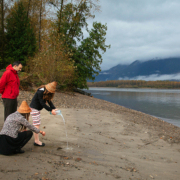
The Suquamish Tribe – known as “The People of the Clear Salt Water” in their Southern Lushootseed language – have fished and gathered shellfish in and near Puget Sound from time immemorial. The waters around Naval Base Kitsap make up much of the Tribe’s treaty-protected fishing and shellfish harvesting areas.

The Navy’s ongoing sewage discharges often result in the posting of health advisories and the closure of beaches where Suquamish tribal members harvest shellfish. Some sewage spills have prompted recalls of commercially sold shellfish. Other spills have interfered with the harvest and sale of salmon.

“This lawsuit is not just about how these dangerous spills affect the Suquamish Tribe,” said Forsman. “The entire Puget Sound community deserves clean water. The shellfish, the orca, and all sea life rely on clean water, and all of our children – and children’s children – deserve clean water.”

“This is why the Clean Water Act was created. It’s time for the Navy to obey the law and start protecting our waters right here at home,” said Forsman.
Call To Artists: Artists Needed for 2019 A Time to Gather

Call for Artists for 2019 “A Time to Gather” Benefit Dinner Auction

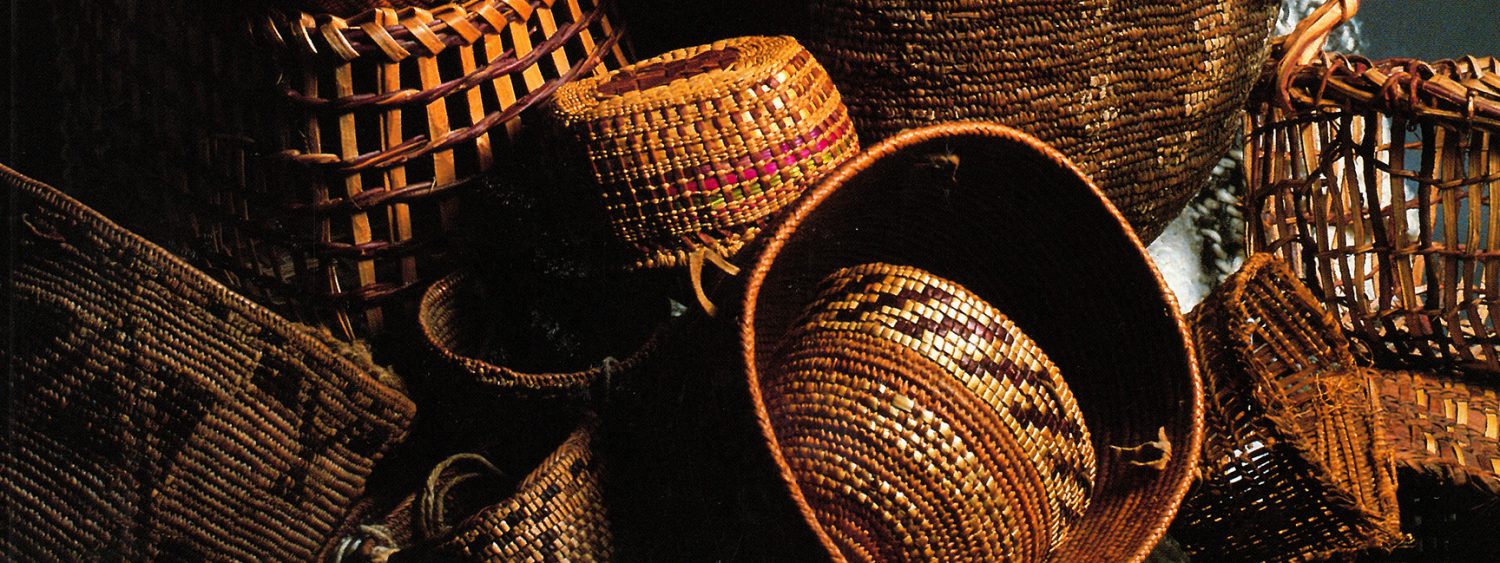
The Suquamish Foundation invites donations of art from traditional and contemporary Native artists for its 2019 annual dinner and auction, “A Time to Gather”.  The proceeds will benefit the Suquamish Foundation.  Works such as carvings, drums, weavings and baskets, jewelry, shawls and blankets, prints, drawings and sculpture are sought for the auction.  Artists making donations will receive recognition in the auction catalog and two complimentary tickets to the event.

This is an excellent opportunity for emerging and established artists to support the cultural resurgence of the Suquamish People and to have their works seen by the community, business leaders, government officials and patrons of the arts.  Previous year’s auction has been sold out in advance and attracted an audience from throughout the Puget Sound Region.  This year the evening will feature a cultural performance.  Traditional music will be provided by the Suquamish Song and Dance Group, which has performed regionally as well as locally. Guests will enjoy a gourmet dinner of traditional foods followed by the silent and live auctions.

WHEN: Target date to have all donations received is April 15, 2019 in order to allow us time to photograph and catalog each piece.  A description of the piece and one or two sentences about the artist is encouraged.

For more information please contact Margeaux Lewis at (360)394-8453 or by email mrlewis@suquamish.nsn.us

A Time to Gather - April 27 2019

Suquamish Foundation Announces Date for A Time to Gather

Please join us at the beautiful Kiana Lodge on Agate Passage for a springtime evening rich with friendship, fun, great food, music and entertainment and our exciting, signature auction event on April 27, 2019. Our auction features original traditional and contemporary Native art as well as our unique cultural experience items such as a local archaeology tour, an indigenous food cooking class or a canoe voyage around Agate Passage.

Thanks to the generosity of those who participated in our annual event in the past and are involved this year, we are able to continue to strengthen the cultural resurgence of the Suquamish Tribal community as well as the friendships of our fellow non-profits, neighbors, and visitors. We will journey into the future by honoring the past and we guarantee a payback of a brighter future to share.

The Suquamish Foundation, created in 2005, is the non-profit arm of the Suquamish Tribe and is dedicated to supporting the culture, education, environment, health and vitality of the Tribal community and its neighbors.  We completed the inspiring Building for Cultural Resurgence capital campaign that built our Suquamish Museum, Community House, Early Learning Center, Veteran’s Memorial, Health and Fitness Center, Community Ball Field and Community Dock. We also award over $300,000 annually to schools and non-profit organizations that serve Kitsap County.

To purchase tickets to our annual fundraising event, visit the foundation online by clicking here or contact Margeaux Lewis at mrlewis@suquamish.nsn.us or by phone at (360)394-8453. Tickets go on sale by February 15, 2019.

Suquamish Hosts Traveling Canoes

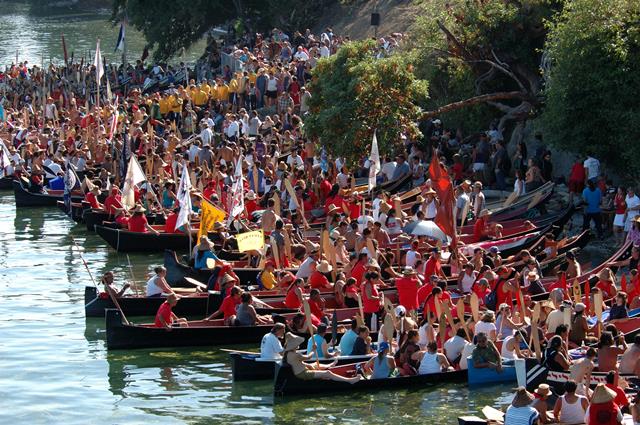
Canoes landing in Suquamish in 2009

Canoe season is well underway and here on the Port Madison Indian Reservation we will soon be welcoming our relatives to our shores for the Suquamish hosting of this year’s Tribal Journey, Power Paddle to Puyallup.

We expect our hosting to be rather large this year, with dozens of canoe families arriving on July 25, 2018 for an overnight stop on their way to Puyallup. When they arrive, we will welcome their canoes from the water and invite them to share songs, dances and meals with us at the House of Awakened Culture before we join them on the way to Puyallup the next morning.

Many of our neighbors and community members are familiar with Tribal Journeys. In Suquamish, we have been a part of the cultural resurgence since the 1989 Washington Centennial Paddle to Seattle. It is a deeply cultural event that provides us an opportunity to practice our traditional ways with one another, reaffirm our heritage and teach our youth.

We appreciate our friends who have volunteered throughout the years to assist us in making our relations feel welcome. For new neighbors and community members just learning about Tribal Journeys, we would like to share a few details about the event that will help ensure we provide the best possible hosting for our relatives and guests again this year.

Welcoming
Our relatives will arrive by water, landing in canoes near the Charles Lawrence Memorial Boat Ramp in downtown Suquamish between noon and 4 p.m. on July 25, 2018. The exact time of their arrival will depend on the weather, and tides. This year, we expect to welcome 65-75 canoes along with their support teams and ground crews. Community members and neighbors often watch the ceremonial welcoming from along with waterfront. If you plan to attend, we ask that you be respectful of the ceremonial welcoming area on the beach. Feel free to take and post photos on social media, record and stream live. However, we ask that you do so from the bluff above the beach or the dock, not from the beach where the ceremony is taking place.

Meals
As part of our hosting, we provide a large outdoor meal for our guests, and those in our community who are participating in Tribal Journeys. As our traditions teach us, we serve our elders, those pulling in the canoes and our guests traveling for the journey first – then, we serve our tribal community and volunteers working the event.

Protocol
After our meal, canoe families will gather at the House of Awakened Culture to share songs and dances. Each canoe family is given the opportunity to share. With dozens of canoe families expected this year, the festivities may last well into the evening hours. Many of our relations and guests watch the event from inside the House of Awakened Culture. If you plan to attend and find yourself inside the house during protocol, please make sure to stay off the protocol floor (where dances and songs are shared). Additionally, listen to see if a song or dance should not be recorded. Canoe families usually make an announcement beforehand.

Camping
We expect around 5,000 campers the evening of July 25, 2018. Most visiting canoe families will camp for the night in areas we designate for Tribal Journeys camping including the green space across the street from the Tribal Center on Suquamish Way, the Football Field near the Suquamish Fitness Center and several individual camping sites throughout Suquamish. Signs are clearly posted at all camping areas. All camping areas will be cleared by the evening of July 26, 2018 when the canoe families move on to Muckleshoot, the next stop on the journey to Puyallup.

For a schedule of events in Suquamish, click here.

For more information on the journey this year to Puyallup, visit www.paddletopuyallup.org

For more information on Tribal Journeys, visit: https://en.wikipedia.org/wiki/Tribal_Canoe_Journeys


Return of the Shores

The Suquamish Tribe is celebrating the return of 36 acres located on the shores of the Port Madison Indian Reservation.
“For us, it’s a homecoming. We will once again be able to walk the lands in the heart of our community,” said Suquamish Tribe Cultural Coordinator Tina Jackson.

On May 31, 2018 the 50-year lease of the area known as Suquamish Shores expires, returning control of the property to the Suquamish Tribe. Tribal government officials have been anticipating the return for more than two decades, working closely with the Tribal community to create a comprehensive long-term plan for the area.

“Our community has been clear in their desire to create a multi-use space, along with additional housing and facilities for our elders,” said Suquamish Tribal Council Vice-Chairman Bardow Lewis.

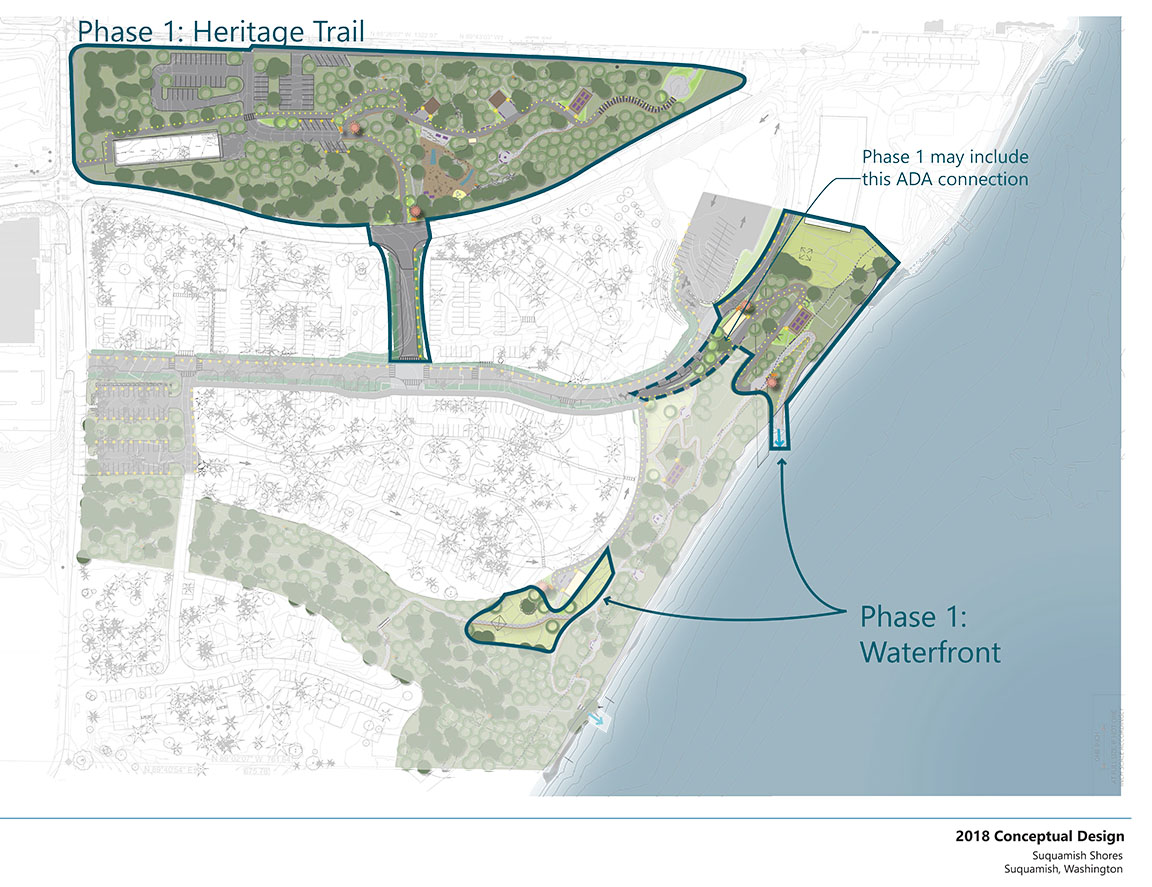
As part of the plan, the property will be redeveloped in three phases over the next ten years. Work on phase one, which includes community spaces, is scheduled to begin in late summer 2018. Plans call for a park near the Suquamish waterfront, along with walking trails and a culturally-themed playground connecting the Suquamish Museum to the Veteran’s Monument near the House of Awakened Culture.

A preliminary concept rendering of Phase 1 includes a heritage trail and cultural use areas.

“We have a lot of site preparation to do. There are a number of homes in disrepair that have to be removed before rebuilding can take place,” said Suquamish Tribe Department of Community Development Director Scott Crowell.

Construction of the first phase is expected to continue through 2019, with a scheduled completion date in 2020. Designs for phases two and three are still being finalized and will include staged elders facilities and housing.

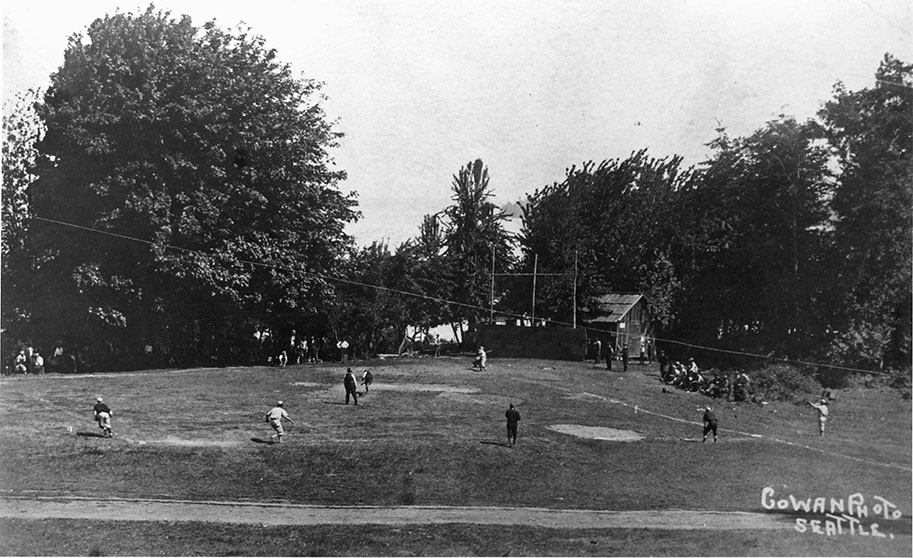
“It makes sense that the Suquamish People would want to ensure the property is redeveloped for recreation, housing and cultural use. Traditionally, a large portion of that property was used as a community gathering space. A ballfield was built there in the late 1800’s and was utilized by the community for several decades before the property was leased,” said Suquamish Tribe Historic Preservation Officer Dennis Lewarch.

Early 1900s’ photograph of a baseball game at the original Suquamish Ballfield. Courtesy of the Suquamish Museum.

The subject of the lease has been a contentious issue in the Suquamish Tribal community over the last five decades. Many members voiced their opposition to the move in Tribal Council meetings when the lease was being considered in 1967. However, faced with limited resources and the need to provide basic government services, the Suquamish Tribal Council determined the lease was the best course of action for the future of the Tribe.

“Back then, we didn’t have any money at all. Tribal Council Meetings were held in people’s living rooms. Paperwork, applications, travel to BIA offices in Everett and Portland just to maintain our treaty rights; it was all done by volunteers, on our own time with our own money,” said Tribal Elder Rich Demain, who served on Tribal Council in 1961.

The agreement for the 50-year lease began in July 1968, with Chief Seattle Properties, a non-tribal corporation, paying the Tribe $7,250 annually for the land. The firm then profited from sub-leasing parcels to individuals looking to build on the waterfront property. Chief Seattle Properties later walked away from the project, leaving those who built homes and the Tribe to sort out the details of their individual leases- a process that would take several years and test the relationships between Tribal Members and their neighbors living on the Port Madison Indian Reservation.
Read the Seattle Time 2007 guest editorial on the Suquamish Shores 

“It’s certainly been a long road. I have looked forward to this day for 50 years, and will celebrate when we will be in control of our own resources again,” said Tribal Elder Ed Carriere.

A Time to Gather 2018 Raises 59k

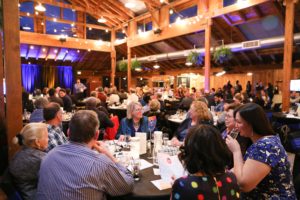
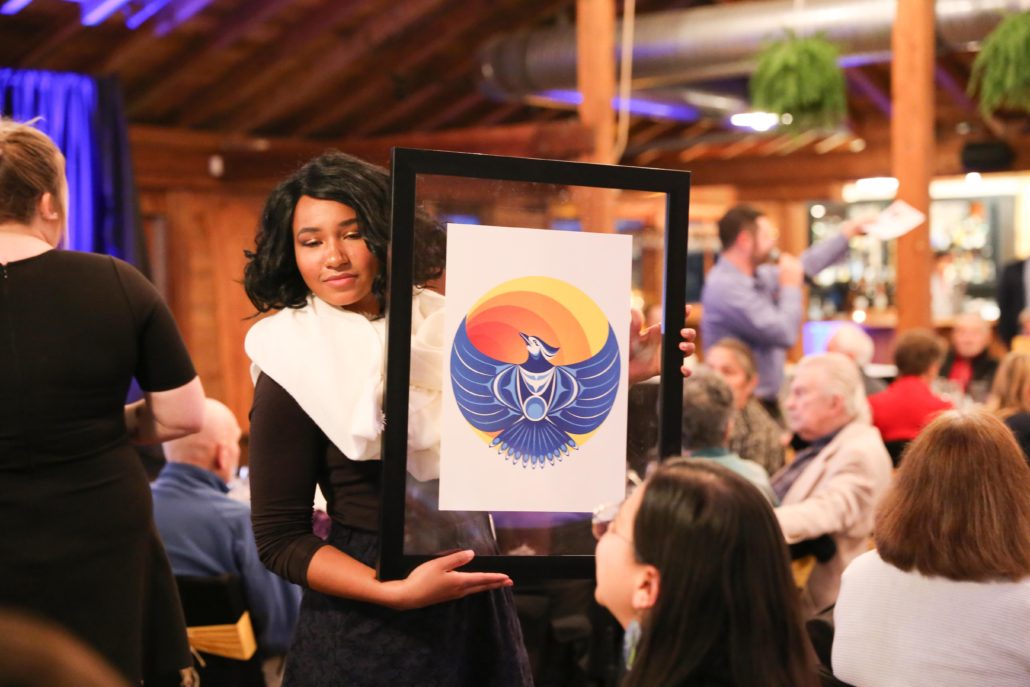
Another successful and enjoyable night of gathering with friends and supporters of the Suquamish Tribe was hosted by the Suquamish Foundation at the Kiana Lodge in Poulsbo. The evening’s theme “How Blue Jay Saved Daylight”, a story told by Suquamish parents to their children for generations, was incorporated into most every detail of the evening and artist and Suquamish Tribal Member, Kate Ahvakana, very graciously created the beautiful image “Sunrise Flight” that was showcased throughout the event décor that evening.

Over 200 guests strolled into the elegantly relaxing atmosphere of Kiana to enjoy the jazz guitar playing of Suquamish Tribal Member, Maxwell Dawes.  Once you’ve entered the beautiful atrium of Kiana’s dining area, you can’t help but notice the assortment of themed gift baskets donated by local businesses and original art work displayed for auction by Native artists such as Preston Singletary, Virginia Adams, Jeffrey Veregge and James Price.  Our delicious 3-course dinner was followed by an exciting, fast-paced live auction and an enchanting Suquamish Tribal youth performance of a play based on the Suquamish legend “How Blue Jay Saved Daylight” featuring performers ages 2 years to 11 years old; Dionicio Lawrence, Amaya Lawrence, Everly Sigo, Corrina Sigo, and Shyla Villa. The youthful performers were assisted by Kylie Cordero and the performance was narrated by Suquamish Foundation Director, Robin Little Wing Sigo.

The story-telling theme of the event and the participation of many of our Tribal children showcased the focus of our 2018 fund raising efforts on the new children’s playground to be built on the property known as Suquamish Shores, which is coming back into the Tribe’s ownership and will be transformed into a beautiful community area over the next several years.  The playground will feature nature-based play structures of wood, sand and water echoing the stories and legends from our oral tradition.


With the help of community, friends and sponsors, the Suquamish Foundation raised almost $59,000 towards the Suquamish community playground with natural play elements. The Tribe is working with Suquamish storytellers, artists, dreamers and children to ensure that it will foster activity, dialogue, education and intergenerational connection so that we may incorporate many local Suquamish stories such as “How Blue Jay Saved Daylight” and “The Story of the Cruel Owls” into play. To see more photos from the event click here.

Suquamish Tribe – A Learning Culture

Suquamish Tribe – A Healthy Culture

Saved By Salmon – Northwest Treaty Tribes