

Tribal Council approves new EHR for Healing House
Suquamish Tribal Council, at their regular meeting on Oct 28, approved the new Electronic Health Record (EHR) system that will be used by health and wellness professionals at the Tribe, marking the next major milestone towards fully opening the Healing House health clinic.
At the recommendation of Dr. Kristine Ewing, the clinic’s medical director, Council approved eClinicalWorks to serve as the Tribe’s backbone for recordkeeping and secure client communication to be used by both the Healing House and Wellness Center staffs.
With hiring now underway for a variety of key positions at the new health clinic, Ewing said there will be a 10-12 week training for staff to use the software and integrate it with other providers throughout the region.
Ewing also introduced Dr. Alex Kraft, the naturopathic physician and acupuncturist who has worked part-time at the Wellness Center for the past eight years and is now joining the Healing House team a full-time provider.



COVID-19 Boosters and Flu shots at Healing House clinic
Drive-up flu shots and Omicron Covid-19 boosters are available to Suquamish Tribal Members, Tribal Government staff and PME employees at the Healing House health clinic on Tuesdays and Thursdays from 8:30 am to noon.
The bivalent Omicron booster is available to those who have already had two boosters as long as it has been two months since your most recent shot. It is also available to those who are pregnant or breastfeeding. Standard pediatric COVID-19 vaccinations are available for children 6 months and older.
Call (360) 394-8469 to schedule.

Forsman urges action on Indian Boarding Schools Commission
Suquamish Tribe Chairman Leonard Forsman called on Congress to establish a Truth and Healing Commission on Indian Boarding Schools in an op-ed published today in the Seattle Times.
The call for action comes on Orange T-Shirt Day or — more formally — Day of Remembrance for Indian Boarding Schools.
“We need to learn more, including the number of children forced to attend the schools, the number who were abused, died or went missing,” writes Forsman. “And we need to know the long-term impacts on the children and the families of children who were forced to attend the Indian Boarding Schools. The Truth and Healing Commission can help with this much-needed investigation.”
Forsman also said more work is needed in identifying the best ways to address the trauma inflicted on Native communities during the boarding school era.
“Many of the students adapted, endured and found ways to overcome and succeed within the system, and became mentors and leaders of their tribal nations despite the intent of the boarding school system. Still, many suffered in the past and many former students and their offspring continue to struggle today,” writes Forsman. “Anger and resentment are justified, but we must commit ourselves to the healing process.”
You can read Forsman’s full column here.
King County Unanimously Approves Settlement with Suquamish Tribe over Sewage Spill Dispute
‘The People of the Clear Salt Water’ say Puget Sound community deserves better
The King County Council voted unanimously Sept. 27 in favor of a landmark settlement with the Suquamish Tribe to redress the repeated release of sewage into Puget Sound from the County’s wastewater collection and treatment system.
“The Suquamish Tribe is pleased that King County recognizes the seriousness of this issue and worked with us to protect Puget Sound,” said Suquamish Tribal Chairman Leonard Forsman.
The settlement is designed to curtail further wastewater pollution of Puget Sound from King County facilities, including the West Point Wastewater Treatment Plant (WPTP). The settlement also funds ecological restoration projects in Puget Sound that will support the recovery of salmon, orca, and other marine life, and it compensates the Tribe for past releases that continue to impact Tribal fisheries.
Settlement talks began following a July 2020 notice from the Suquamish Tribe that it intended to file a lawsuit for violations of federal clean water law and for infringement on the Tribe’s Treaty rights.
Chronic wastewater pollution impacts marine ecosystems and treaty rights
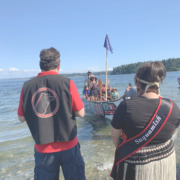
“In 2019, tribal canoe families from all over the Salish Sea landing in Suquamish during the annual Tribal Canoe Journey had to paddle through one of the county’s largest untreated sewage spills. This pollution, created an immediate health hazard for the tribal community and disrupted an important cultural event,” Forsman noted.
“The Tribe took legal action when it became clear that the County was failing to protect the water quality in Puget Sound as required by the Clean Water Act, and the pollution was interfering with our Treaty fishing rights,” Forsman said. “We could no longer stand on the sidelines hoping conditions would improve.”
The 2019 event was just the latest in a series of pollution events. In July 2020, the Tribe notified King County that it was responsible for at least 11 significant illegal discharges of untreated sewage from the WPTP into the Tribe’s treaty-protected fishing areas, with individual discharge events ranging from 50,000 gallons to 2.1 million gallons. The Tribe further notified King County officials of the Tribe’s intent to file a lawsuit for ongoing violations of the Clean Water Act and its National Pollutant Discharge Elimination System (NPDES) Permit.
Unlawful discharges of sewage foul the water and habitat for aquatic species, result in closure of beaches where Suquamish tribal members harvest shellfish, prompt recalls of commercially sold shellfish, interfere with tribal member harvest and sale of salmon, and disturb important cultural activities such as the annual Canoe Journey. Fecal coliform bacteria pollution is a persistent threat to human health, and the safe harvest and consumption of fish.
The discharges also foul beaches and waterways enjoyed by non-Native residents of King County, Bainbridge Island, Kitsap County and throughout the Puget Sound.
One of the purposes of the Clean Water Act is to eliminate untreated sewage discharges such as those that have been occurring regularly in Puget Sound and to protect the health of all citizens.
Sewage pollution from King County’s outdated wastewater treatment processes are not new. In 2013, King County entered a consent decree with the State of Washington and the Environmental Protection Agency (EPA) to address serious and ongoing sewage discharges from the County’s wastewater treatment facilities and combined sewer outfalls. In spite of the consent decree and a series of enforcement actions against King County, Clean Water Act violations continued, including major releases from WPTP that repeatedly impacted the Tribe’s treaty-reserved fishing rights and cultural activities.
Settlement terms designed to protect Puget Sound’s fragile ecosystems
The County acknowledges in the settlement that sewage spill events from its wastewater collection and treatment system into the Tribe’s treaty-protected fishing area have impacted the Tribe’s right to take fish and tribal cultural events, and that this pollution has the potential to impact the Tribe’s treaty rights in the future. However, the County does not admit to liability for any alleged violations.
The settlement agreement requires the County to upgrade infrastructure to eliminate or reduce further untreated discharges from King County wastewater and sewage facilities into Puget Sound. The agreement also requires compensation to the Suquamish Tribe to cover legal and technical costs associated with the discharges, and to compensate for damages. And, importantly, the settlement requires the County to invest in environmental projects that will make up for the damage to marine habitats caused by the spills.
To address tribal impacts, the County agrees to pay the Suquamish Tribe $2.5 million to compensate for impacts to the Tribe associated with the last five years of discharges and future tribal impacts from any additional spills that might occur through the end of 2024. After January 1, 2025, if any sewage is discharged from WPTP’s emergency bypass, the County will will pay a penalty to the tribal mitigation fund for each spill event.
To reduce or eliminate future untreated sewage spills, particularly at WPTP’s emergency bypass, King County agrees to substantial infrastructure upgrades at WPTP. The upgrades include replacing faulty uninterruptible power supply, addressing voltage sag, and creating redundant capacity to deal with peak flows. A strict and enforceable penalty framework is tied to the infrastructure upgrade deadlines, and if missed, the County is required to pay $40,000 for a missed deadline and $10,000 for each additional month of delay
“This framework holds the County accountable for protecting the water quality in Puget Sound,” said Chairman Forsman.
The County will complete supplemental environmental projects tied to nearshore habitat restoration or other mutually agreed environmental protection projects in the amount of $2.4 million within five years.
“The Tribe is pleased that the County negotiated in good faith to protect our shared waters. This settlement will result in significant steps towards protecting the marine life of Puget Sound,” Forsman said
“The entire Puget Sound community deserves clean water. The shellfish, orca, salmon, crab, geoduck and shrimp all rely on a healthy marine environment, and all of our children – and children’s children – deserve clean water,” said Chairman Forsman.
Good Neighbors Luncheon
Please let us know if you can attend the Good Neighbors luncheon, taking place at noon on November 1, 2023, at the House of Awakened Culture in Suquamish.
Suquamish government tightens COVID precautions
With COVID-19 rates increasing within our workplace, across the Reservation, and throughout the region, we are updating the Tribal Government’s requirements for staff and guests. The following changes will go into effect beginning Tuesday June 21:
- Physical Distancing – A minimum three-foot separation from others is now required inside all Government-owned facilities.
- Masks – The use of approved face masks is now required while inside Tribal Government facilities, vehicles, and vessels when in the presence of others.
- Employees may remove their mask while at their desk, provided they are not working with clients and guests and are able to maintain a minimum three-foot distance from other employees.
- Occupant load restrictions remain at their normal level, but with adherence to the required masking and physical distancing referenced above.
- Guests and visitors — Guests are also required to wear a mask and maintain at least three-foot separation when inside Tribal Government facilities. Appointments with clients and guests are strongly encouraged.
- Working outside – The use of approved face masks is highly recommended while outdoors, but is not required when a 3-foot minimum distance cannot be maintained.
- Remote work – If a Tribal Government employee’s job function allows, they may telecommute if approved by their supervisor; all other employees are expected to report to work as they are normally scheduled.
Please Remember:
- Follow all the safe practices that have helped to keep us all safe. i.e., minimize exposure risks, disinfect and sanitize, practice good hygiene, stay home when sick, etc.
- Employees who are symptomatic or who become symptomatic during the day should be immediately separated from others and sent home. They should follow-up with a PCR COVID-19 test in accordance with testing protocols.
We will continue to monitor local case rates over the next few weeks and will adjust our safety measures accordingly. Thank you in advance for your cooperation. With your continued commitment, we’ll be able to keep our co-workers safe.
NOTE: Early Learning Center and CKA families, please see special protocols for your students.