
‘Brown water’ advisory for tribal housing neighborhoods
How to get your clear water back on tap
The Suquamish Tribe maintains a well that provides water to homes in several tribal housing neighborhoods, as well as the Marion Forsman-Boushie Early Learning Center, Family & Friends Center, Fitness Center, and Ball Field sprinkler system. The water is treated with chlorine to protect public health.
When the water runs with a brownish tint it usually means water flow has been briefly disturbed, lifting up water sediment. Traces of manganese, a naturally occurring metal in the sediment, causes the brown hue. The water clears when the sediment settles.
Manganese does not pose a threat to public health.
Still, we know it doesn’t look good. That’s why the Suquamish Water Utility Program periodically flushes the mains to minimize these occurrences. However, due to increased water usage during summer months, including use of the ball field’s sprinklers and activated fire hydrants, brown water can still show up.
Clearing it out: Dos and Don’ts
If brown water occurs at your location, there are some things you can do to help clear it out. Here are some dos & don’ts to keep in mind:
Do run your water on cold – You can speed this by up by also flushing toilets and running spigots. If the water does not clear after a few minutes, turn off water, wait an hour, and then try again.
Don’t run hot water – Running hot water will empty clear water from your hot water tank and fill it with discolored water.
Don’t do laundry – Manganese-tinted water can stain clothes, so wait until it clears before starting your next load.
If you have run cold water a few times and it still does not clear, please contact our staff for additional assistance:
James Old Coyote, Water Utility Operator (360) 394-8509
William Lawrence, Water Utility Manager (360) 394-8506


May is Mental Health Awareness Month
The Suquamish Tribe’s Wellness Center has a slew of events planned for Mental Health Awareness Month through May. All activities are open to the Suquamish Community.
Here’s a round-up of what’s coming up:
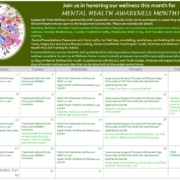
Weekday Wellness Activities: Each weekday of the month of May join us in connecting with ourselves and culture to support our wellness. Monday Meditations, Tuesday Traditional Crafts, Wednesday Walk or Jog, and Thursday Canoe Journey Giveaway making.
Events/Presentations: Please join us in food, crafts, fun field day, storytelling, workshops, and training this month. Frybread Tacos, Happy box and aroma therapy making, Seven Grandfather Teaching for Youth, Nutrition and Wellness Talk, and Mental Health First Aid Training for Adults.
Personal Wellness Journey Booklet: Self-guided booklet utilizing evidence-based and cultural-based practices to support holistic wellness (available for pick up at Wellness Center or electronically at request via email to oponce@suquamish.nsn.us)
31 Days of Mental Wellness for Youth: In partnership with the ELC and Family & Friends Center, Wellness will support both agencies in a 31 days of mental wellness activities that can be done both at the centers and at home.
Check out the May Wellness Calendar for more details.
2023 Communications Survey
Thank you for taking the time to help the Suquamish Tribe communications team serve you better. Please contact us at Communications@Suquamish.nsn.us if you have any questions or requests.
Proposed Tribal Code Amendment
Proposed Amendments: Chapter 5.15- Exclusion of Tribal Members from the Port Madison Indian Reservation
The Suquamish Tribal Council is seeking written comments on proposed amendments to Suquamish Tribal Code Chapter 5.15—Exclusion of Tribal Members from the Port Madison Indian Reservation. Please submit written comments by March 31, 2023. Contact the Office of Tribal Attorney for a copy of the proposed amendments.
Suquamish Tribal Code Chapter 5.15 – Exclusion of Tribal Members from the Port Madison Indian Reservation, adopted by Resolution 2022-170 on October 24, 2022, contains a provision in Section 5.15.1(c) stating that any Suquamish tribal member may be excluded from the Port Madison Indian Reservation and all lands subject to the Suquamish Tribe’s jurisdiction if convicted of a violent crime that results in “serious” bodily injury, as defined by tribal, state, or federal law. The proposed amendments would:
- Revise Section 5.15.1(c) to enable Tribal Council to exclude tribal members who have committed assaults that result in “substantial” bodily injury, as defined by tribal, state, or federal law.
- Revise “Port Madison Indian Reservation” to “Port Madison Reservation” within the title and throughout the chapter.
Submit comments or requests for a copy of the proposed amendments to: Office of Tribal Attorney, STC Chapter 5.15 Comments, P.O. Box 498, Suquamish, WA 98392 or by email with the subject line “Chapter 5.15 Comments” to: bbrueseke@suquamish.nsn.us.
Written comments are due by March 31, 2023. Please feel free to forward this notice to any and all interested people. Thank you.
Suquamish Tribe Emergency Contact Numbers
If you are experiencing a medical or life-threatening emergency dial 9-1-1
Many Suquamish Tribal Government staff are working from home through the office snow closure. Suquamish tribal members and their families can call any of the following numbers for assistance:
CKA – Principal Rex Green (360) 900-6020
Community Health – (360) 265-0170
Education – Director Brenda Guerrero (360) 633-0643
Elders Program – (206) 920-0748 (cell)
ELC – (360) 394-8578
Emergency Management – (360) 394-7197
Facilities & Maintenance – (360) 340-4563 (cell)
Family & Friends Center – (360) 394-7107 or (360) 340-2338 (cell)
Fitness Center – (360) 930-1545
Health Benefits – (360) 394-8424
Health Clinic – Director Steve Kutz (360) 731-2885
Human Services – (206) 920-0748 (cell)
Natural Resources – (360) 394-8442
Suquamish Police Dept 9-1-1
Note: Please do NOT call the Police Department front desk or individual officers in an emergency. It is always faster to get help by calling 9-1-1
TCW – (360) 394-8480 or (360) 900-7009 (cell)
Tribal Court – (360) 900-3008 (cell)
Note: All non-emergent court hearings will be continued to a later date.
Empowering our teens to create healthy relationships
Teen Dating Violence Awareness Month is an opportunity to create awareness about Teen Dating Violence, uplift youth voices, and healthy relationship skill building, and connect young people with resources to help cultivate safety in their relationships. Many Native peoples have the teaching that we are all related, our clans and kinship systems show us how we are connected to each other. Taking care of ourselves and each other is how we practice being good relatives. It starts with cultivating healthy relationships when we are young.
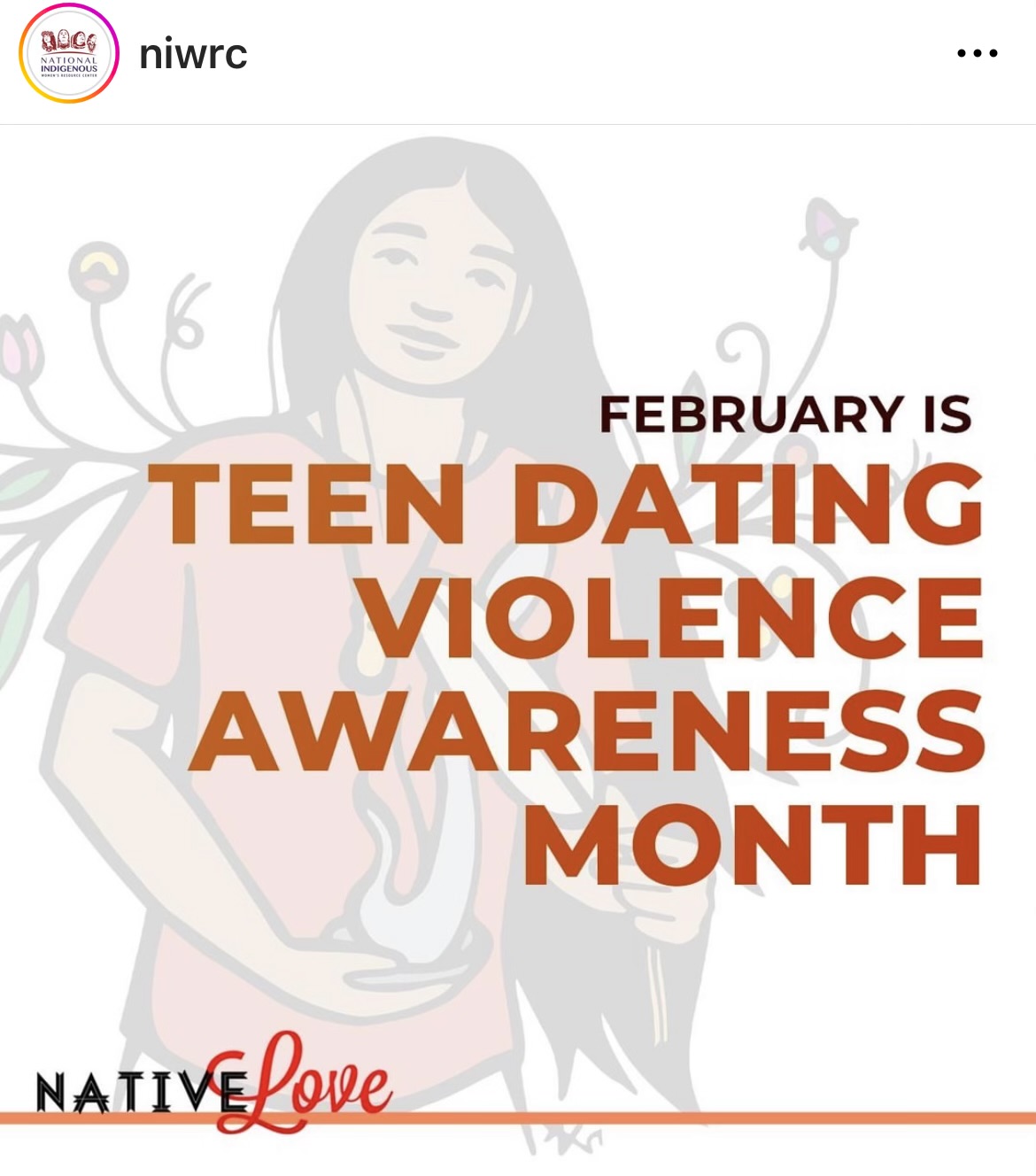 Teen dating violence is an issue in Indian Country that we should understand and actively work to end. It often occurs between the ages of 13-19 but can start as young as 11 years old. 1 in 12 US high school students experience physical dating violence and 1 in 12 experience sexual dating violence. These numbers are very high though this issue is often hidden from others. Many young Native people are suffering in silence. Nobody deserves to be abused. We should be talking about the reality of Teen Dating Violence even if many do not see it. Relationships should be based on respect and care and not power and control.
Native teens deserve to be taught healthy coping and relationship skills like consent and boundaries and prevent Teen Dating Violence. We need support services for survivors of teen dating violence so young people can get the help they need. TDVAM is an opportunity to empower youth to help their peers know where to go or who to talk to if one of their friends confides in them about experiencing dating abuse.
NativeLove and the National Indigenous Women’s Resource Center (NIWRC) work to raise awareness and create educational tools about Teen Dating Violence to support advocates working in Indian Country. Our goal is to empower teens to demand safety in their relationships and uplift their voices. Help support Native youth by raising awareness about Teen Dating Violence and promoting healthy relationships.
Follow, Like, and Share @NativeLoveIs on Instagram, TikTok, and Facebook.
Teen Dating Violence, Defined
Teen Dating Violence is a type of relationship violence that occurs between young people. It is defined as when a person uses a pattern of abusive behavior toward their partner to gain power and control over them. Teen Dating violence can include one or more types of abuse, and can look like this:
- Physical abuse—pushes, shakes, slaps, kicks, or spits on you. Holds you down. Throws or breaks your personal belongings (ex. books, cell phone, etc.)
- Emotional abuse—insults you, calls you hurtful names, or embarrasses you in public. Constantly accuses you of cheating. Threatens to hurt you or expose secrets about you.
- Sexual abuse—unwanted kissing or touching, pressures you to have sex or makes you feel guilty for not wanting to have sex or demands that you send them sexually explicit photos or videos.
- Digital abuse—constantly calls, texts, or DMs you to find out where you are or who you’re with, tells you who you can be friends with on social media, or sends mean messages on social media either directly from them or anonymously, tracking you, or sending sexual messages without consent.
- Cultural/Spiritual abuse—makes fun of your religious beliefs or cultural responsibilities to make you feel shame or embarrassment.
- Financial abuse—steals money from you. Controls how you spend your money.
Some signs of dating violence can include when a partner:
- Acts extremely jealous or possessive of you, follows you home or to school, or shows up wherever you are unannounced.
- Is annoyed or upset when you spend time on the phone with other people.
- Interferes or stops you from doing things alone or getting support from others.
- Tells you who you can or cannot be friends with, starts rumors, or threatens to start rumors about you.
- Excessively texts you or sends non-stop DMs.
- Checks your phone for who texts or calls you.
- Tags you in hurtful social media memes, posts, or pictures.
- Criticizes your dreams, goals, family, or friends.
- Tells you what to wear or how to dress.
- Explodes in anger toward you or acts aggressively when they’re upset.
- Kisses, grabs, or touches your body without your permission.
- Forces you to take sexually explicit selfies or videos.
- Threatens to hurt themselves or commit suicide if you don’t do what they want.
If you know a young relative that is being abused:
- Call or text StrongHearts Native Helpline at 1-844-762-8483 or chat at strongheartshelpline.org.
- Create a safe space and tell them you’re concerned about their safety.
- Be a good relative and listen to their story when they’re ready to share.
- Let them know the abuse is not their fault and they do not deserve it.
- Ask how you can help them.
- Offer support and encourage your friend’s strength and courage.
- Share resources available online or locally from your community.
- Learn about dating violence and the signs of relationship abuse.
- Avoid confronting the abusive person hurting your loved one. It can escalate the situation and put your young relative in danger.
If your friend or relative is being abusive, find ways to let them know their behavior is not acceptable. Ignoring their bad behavior condones and supports it.
Helpful Resources and Activities:
- Invite youth and teens to do the #NativeLoveIs TDVAM Instagram/Tiktok Challenge during the month of February by making a zine about what Native Love means to them for a chance to win a prize pack from NativeLove and NIWRC!
- Register for the NIWRC webinar, ‘Ending Teen Dating Violence and Cultivating Healthy Relationships,’ on February 23 at 1-2:30 p.m. MDT.
- Download or order Youth Magazine: Relationships – Healthy Unhealthy, When There is Danger.
- Explore NIWRC’S Special Collection for Native American Teens, developed to provide awareness resources and promote important discussions about teen dating violence.
- If you need to talk, call StrongHearts Native Helpline at 1-844-762-8483 or chat at strongheartshelpline.org.
- Read blogs, Recognizing Healthy Relationships and Dating Violence and How to Support a Loved One in an Abusive Relationship, by StrongHearts Native Helpline.
- Watch NativeLoveIs videos focused on raising awareness and empowering Native youth to speak out about traditional cultural values that honor and respect Native women.
- Explore the NativeLove Online Toolkit for Youth and Toolkit for Educators Coaches and Mentors for resources to raise awareness about teen dating violence.
- View Signs of Teen Dating Violence and Resources from TeenDVMonth.org.
- Explore the 2023 TDVAM Action Guide by Love is Respect.