
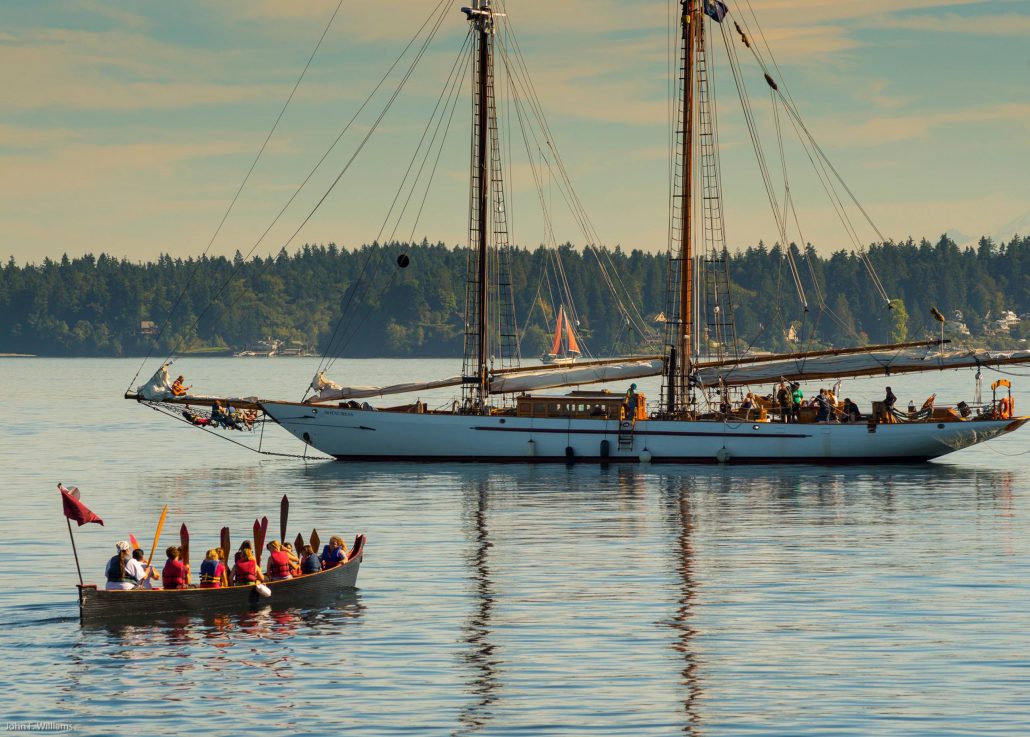
The Adventuress will be moored at the Suquamish Dock April 17-18, 2016.
Adventuress – Puget Sound’s official Environmental Tall Ship – to visit Suquamish on Monday, April 17 during Earth Month. The historic ship is one of only two National Historic Landmark (NHL) sailing ships still in active operation on the West Coast. Special thanks to the Suquamish Tribe for making available the use of the public dock.
Adventuress will be open for FREE Dockside Tours:
Monday, April 17 from 3:00-5:00PM
Visitors can climb aboard the ship and learn about its century-old history with a maiden voyage to the Arctic for the American Museum of Natural History, service for decades with the San Francisco Bar Pilots, and role as an on-the-water education platform for Puget Sound youth since 1963.
Adventuress is owned and operated by the nonprofit Sound Experience with a mission to educate, inspire, and empower an inclusive community that works to improve our marine environment and celebrates our maritime heritage. On occasion, the organization partners with Suquamish youth program staff to develop meaningful programs for young people involving both tribal canoes and Adventuress.
Adventuress sails “not for one but for all” with the core belief that We are ALL shipmates.
For more information, visit www.soundexp.org
It is a common misconception that our community has drug dealers skulking about, offering heroin to passing school children in an attempt to get them hooked on opioids. The truth is far more mundane, and more dangerous.
Of people who start to use opioids, the majority start with prescription pills. The vast majority of our current heroin addicts became addicted when they were prescribed oxycontin by doctors in years past. When oxycontin was suddenly restricted, a large number of people were left addicted, with no source of opioids other than inexpensive brown tar heroin.
Doctors are supposed to access a website, where they can review and confirm that their patients aren’t already receiving opioids from one or more other doctors. Only 1 doctor in 3 uses that system, so 2/3 of the opioids being prescribed are being prescribed “blindly”. Even this isn’t the source of opioids for most new users, though.
Some common prescription opioids are:
Who is the source? Who is getting new users hooked on these opioids? In most cases, it’s you…your family….and your friends. It’s not some shady guy in an overcoat slinging drugs in a dark alley. It’s your medicine cabinet.
According to the 2016 DEA Threat Assessment, “Recent Initiates” to opioids get their pills “obtained from friend/ relative for free or without asking” 66.2% of the time. They get them “prescribed from one or more doctors” 19.3% of the time. Folks…we’re at 85% already, and no drug dealers have been mentioned yet. The remainder is bought from friends and relatives, purchased off of the internet, and a tiny percentage purchased from people we would consider “drug dealers”. The drug dealers account for somewhere between 1-4% of the source.
This isn’t a “police” problem. Just paying for cops and walking away isn’t a viable solution. If we arrested every drug dealer at the Reservation border before they could enter, we’d still have over 95% of the source of these opioids in place.
What about frequent, chronic pill users? They are still getting the pills from friends, family or doctors without cost nearly 70% of the time. They are purchasing them 24.5% of the time, but many of those purchases are from friends and relatives. The police can’t be in your living room every time the family comes over, and you don’t want us there.
Where do the family and friend get all of these opioids? In 83.8% of the cases, from one doctor, who is still following old, incompetent prescribing practices and is prescribing way too much medication when it’s no longer needed. In some cases, the doctor is the culprit; in many cases, it’s us! We don’t use all of the medication, but we keep it in the house, waiting for someone to be tempted.
WHAT CAN WE DO ABOUT IT?
Get all of your unused pain pills out of your house. The Suquamish Police department is the only full time DEA “Drug Take Back” location in Kitsap County. We have taken over 400+ pounds of opioids off of the streets using this program. It’s easy; walk in, drop the pills bottles into the box. Walk away. You don’t even have to talk to anyone. It’s the big green metal box. We clear out the contents and ship them to the DEA for incineration. No cost, no forms, no hassle.
If an elderly or disabled family member is hospitalized, moves to a nursing home, or passes away it is critical to get their prescription pills collected and dropped in a drop box for destruction.
If you have young people in your life, and they get a sports injury, or have a minor surgery, do NOT let them be prescribed opioids. Recent studies show that any use of opioids prior to the age of 18 leads to a 30% increased chance of opioid addiction as an adult.
What about overdoses? Heroin is far more dangerous than prescription pills, right? This answer is, historically, no. Prescription opioids have killed dramatically more users than heroin. Even today, with the extremely dangerous fentanyl laced heroin, prescription opioids are still killing more people here in Washington State. Of all opioid overdoses, prescription opioids are killing users roughly 60% of the time, with heroin killing the other 40%.
If you or someone you know needs to use opioids, ask for a prescription of nasal naloxone at the same time, so you have the antidote to go with the medication, in the event of an overdose. Tell everyone in your household where the Naloxone is kept.
Chief Lasnier is Vice Chair of the Opioid Steering Committee for Clallam/ Jefferson/ Kitsap Counties, working cooperatively as a team with doctors, treatment providers, mental health workers, police, prosecutors, courts, emergency medical staff and responders and others to find solutions to this opioid challenge. It’s going to take all of us, and more importantly it’s going to take all of you!
IF YOU ENCOUNTER SOMEONE WHO MAY BE EXPERIENCING AN OVERDOSE:
Check for signs of overdose:
Call 911. Tell the dispatcher where you are and that someone is not breathing or is unconscious.
If you are trying to help in an overdose, WA State’s 911 Good Samaritan/Overdose Law protects both you and the overdose victim from drug possession charges.
Don’t be afraid to call 911 for help!
If you are trained in 1st Aid or CPR, proceed as you were trained. If not, the 911 operator will help you until assistance arrives.
Next time: The Opioid Crisis Part 2: Heroin

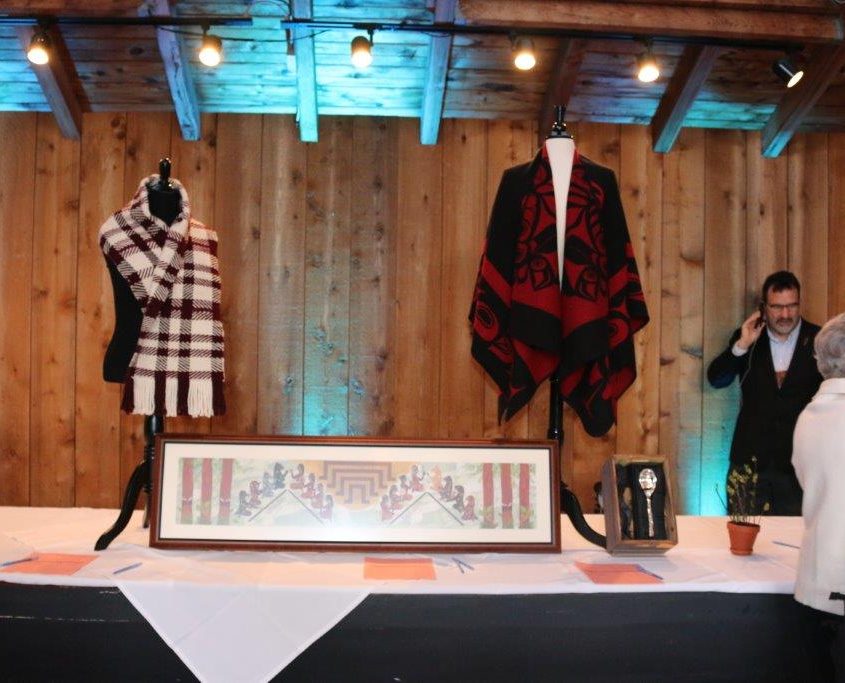
A silent auction table at the Time to Gather event, held on Friday, March 24 at Kiana Lodge.
The Suquamish Foundation held its annual “A Time to Gather” fundraising event Friday, March 24, at Kiana Lodge. The sold-out crowd of enthusiastic bidders helped the Foundation reach its $50,000 fundraising goal, the proceeds targeted for a planned playground, the Suquamish Museum, and benefiting programs from the broader community.
Guests were welcomed by Tribal Chairman Leonard Forsman and Foundation Manager, Angela Flemming who presented a brief history of the event, its purpose and importance to the Suquamish Tribe. Happy attendees enjoyed a delicious meal of either cedar-wrapped salmon, apricot chicken or braised eggplant, all prepared by the experienced staff at Kiana Lodge.
Standout live auction items included a traditional medicinal herbs gathering excursion with Noel Purser-Rosario, a Port Madison Indian Reservation tour led by Tribal Chairman, Leonard Forsman, two limited edition serigraphs by Preston Singletary, a 3 day-2 night Alaska Fishing Adventure, and an original brush and ink painting of the Traveling Coyote by Emma Noyes. Bidding was spirited and exceeded the valued price for the benefit of the Suquamish Foundation.
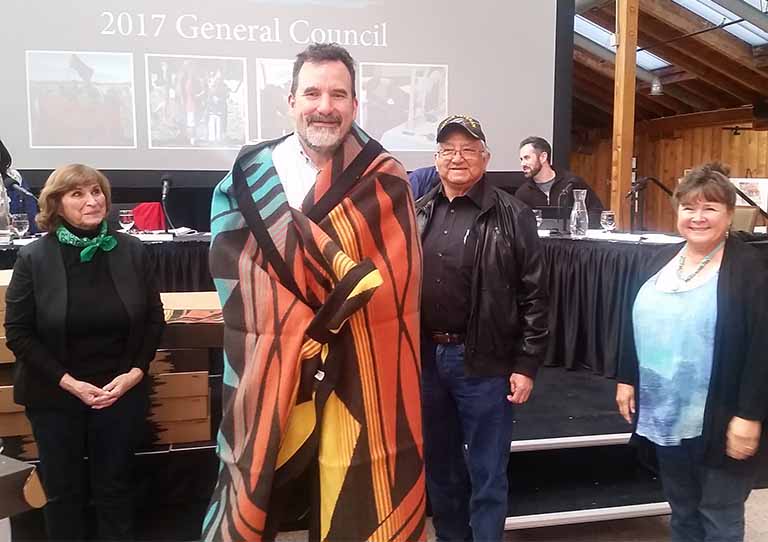
In addition to being reelected at Suquamish Tribal Chairman, Leonard Forsman was also honored as a new member of the Suquamish Elders- a designation given to Tribal Members when they turn 55 years-old.
The Suquamish Tribe annual General Council meeting was held March 18-19, 2017 at Kiana Lodge. In addition to hearing reports from departments throughout government and business operations, Suquamish Tribal Members also had the opportunity to vote for Chairman and Secretary of the Suquamish Tribal Council. A total of 355 Tribal Members voted in the election.
Two people ran for the Chairmanship, incumbent Leonard Forsman and Wayne George. Forsman won re-election with 68 percent of the vote. There were four candidates nominated for Secretary. Nigel Lawrence was re-elected to the position with 120 votes. Matt Hawk Sr. ran and received 113 votes. Votes and remaining candidates were Randy George (78) and Linda Holt (45).
Forsman has served as Chairman of the Suquamish Tribe since 2005. In addition to his position on council, he is also the Vice-Chairman of the national Advisory Council on Historic Preservation. He is a graduate of the University of Washington and holds a master of arts in historic preservation from Goucher College.
This is the third time Lawrence has been elected to the Suquamish Tribal Council, and his second consecutive term. In addition to his position on council, Lawrence is the Director of the Marion Forsman-Boushie Early Learning Center and a graduate of Eastern Michigan University.
The council consists of four officers; Chairman, Vice-Chairman, Treasurer, Secretary; and three at-large Council members. The Chairman only votes in case of a tie. Tribal Council officers and members serve three-year staggered terms. The Tribal Council meets on alternate Mondays and as needed throughout the year. For more information, visit the Government section of our website.
Suquamish vocalist Calina Lawrence to be featured performer at Suquamish Foundation’s popular spring event.
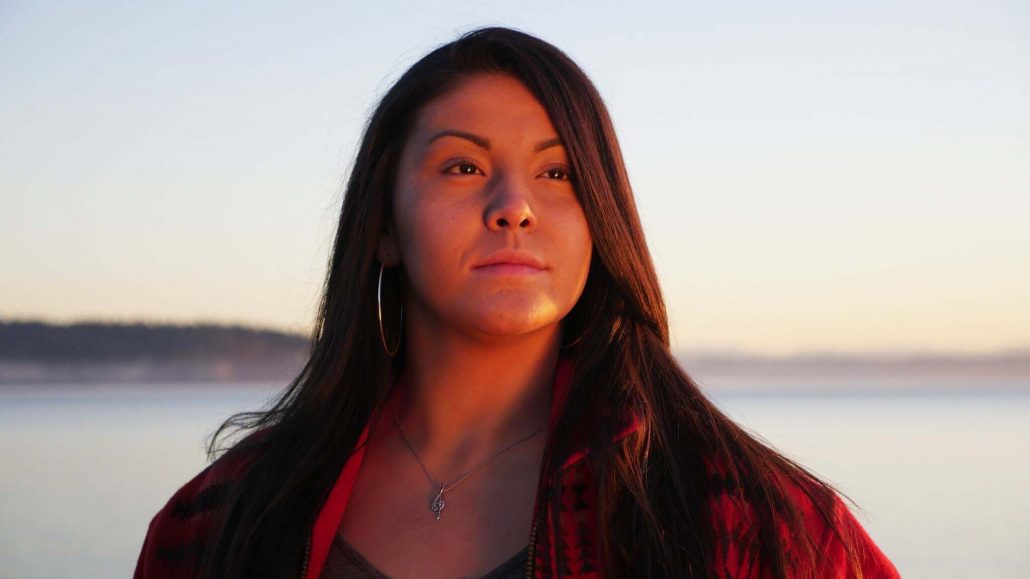
Vocal artist and activist Calina Lawrence (Suquamish).
Vocal artist and activist Calina Lawrence will be performing at the annual Time to Gather event this year. A member of the Suquamish Tribe, Calina Lawrence was born and raised within her Indigenous culture in the Northwest area of Washington State. Her vocal journey began at a young age when she was first introduced to her cultural music. Lending her voice to the preservation of Suquamish traditions, she also grew to love singing many modern genres. She was raised knowing the importance of spreading awareness about the social injustices that have impacted the quality of lives on tribal reservations and within urban Native communities. Her involvement in her cultural music has led her in activism in the cities of Seattle, San Francisco, and Oakland. Lawrence recently graduated with Honors from the University of San Francisco, attaining her BA in Performing Arts & Social Justice; a Music concentration. She has spent recent time traveling the country in advocacy for Native Treaty Rights and the “Mni Wiconi” (Water is Life) movement lead by the Standing Rock Sioux Tribe. She dedicates her artistry and energy to POC racial injustice, police brutality, mass-incarceration, gentrification, misrepresentation of Native Americans in education/mainstream United States media, climate injustice, blood quantum and enrollment issues, foster youth, suicide prevention, and many other causes. Since graduation, she has released her debut Single entitled “Alcatraz” January ‘17 and will be releasing her first album later in the year.
A Time to Gather is an annual fundraiser that includes live performances, dinner and an art auction with proceeds benefiting the Suquamish Foundation. This year, the event will be held at Kiana Lodge on Friday, March 24, 2017. Tickets for the event are available online for a limited time.
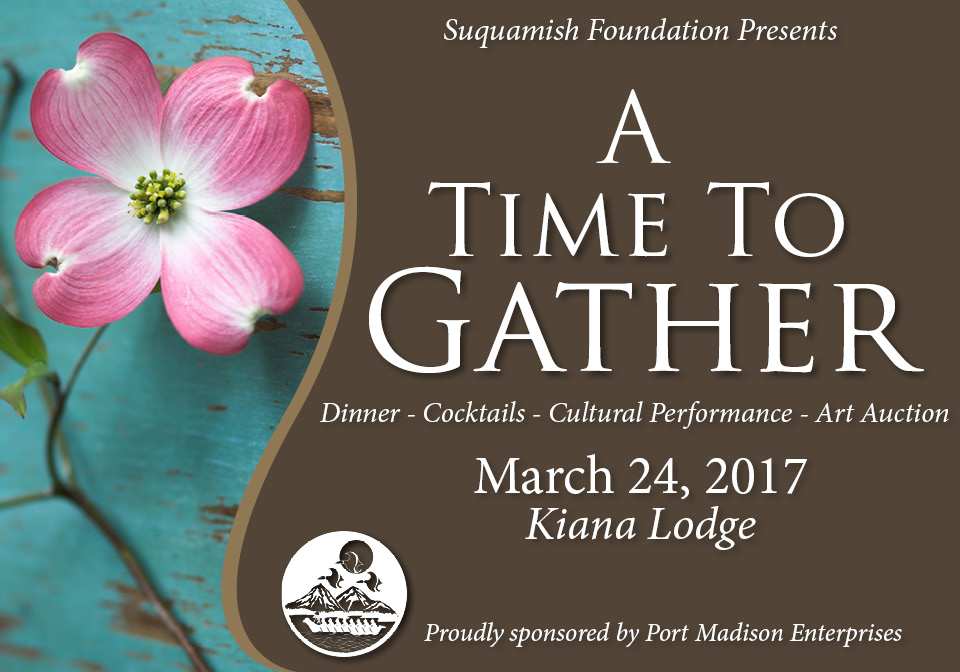 The New Year is here. What does it hold for us? Times may feel uncertain. And yet, one thing is absolutely certain; for those who treasure the sacred, priceless beauty of the cultural, historic and environmental values of the Puget Sound, it will be a year of true celebration and accomplishment. It is truly a year to honor that, to share that, and, yes, to thoroughly enjoy that at a party! Let us joyfully celebrate together at the Suquamish Foundation’s 2017 “A Time To Gather” community event on March 24th. This will once again be held at Kiana Lodge, one of the most beautiful seaside venues in Washington State.
It has now been 12 years, since the Suquamish Tribe chartered its’ non-profit organization, the Suquamish Foundation. The Foundation invited a wealth of enthusiastic partners and supporters to raise $20 million dollars to launch an incredibly successful “Building for Cultural Resurgence Capital Campaign “. Together we realized a vision for a renovated downtown Suquamish with a beautiful new Museum, Community House, Community Dock, new Early Learning Center and a brighter future.
This work goes on! It is exciting to see such positive change in a few short years, to recognize the generosity of so many contributors and come together to support and celebrate our on-going work and mutual benefits. The Suquamish Foundation will now focus on a new Community Playground, a vigorous fight against drug and alcohol addiction, and enhancing the cultural collections at the Suquamish Museum.
At A Time To Gather, March 24th from 6 to 9 p.m., we will be providing dinner and cocktails, an amazing cultural performance and a brilliant art auction of original pieces as well as auctioning unique cultural experiences such as a voyage in one of the Tribal canoes. Please join us for this vibrant event and revel in our successes and support our brighter future. We will wrap you in a metaphorical blanket of honor, love and solidarity. To purchase tickets, click here! To see photos from last year’s event, click here.
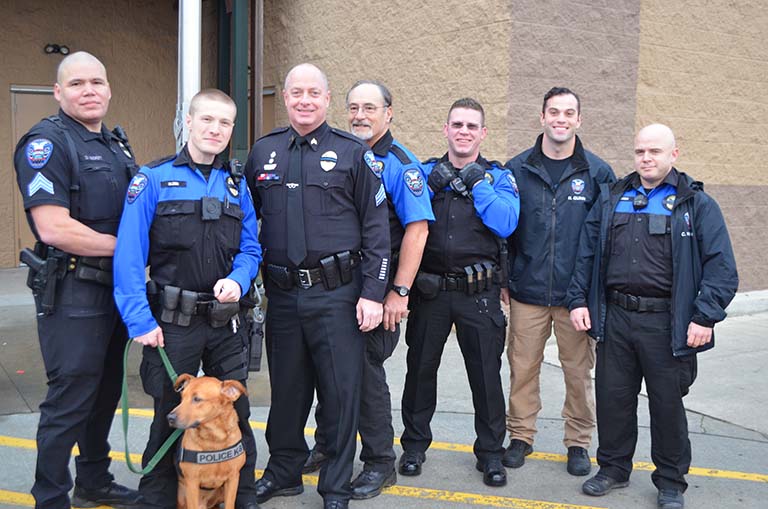
Suquamish Police attending the Shop with a Cop event in Poulsbo, WA.
Did you know that Suquamish Police Officers get over 400% more training each year than the State of Washington requires? Or, that we have the toughest ongoing fitness requirements for Patrol Officers in the United States?
Today, training is incredibly relevant to Law Enforcement. The most important areas of training are topics which are called “High Risk/ Low Frequency” events. Those are things that don’t happen often, but that are dangerous or life-and-death when they do occur, such as armed robberies and performing CPR. If we do something every day, like traffic stops, we get pretty good at them. If we only do something once every 2 or 3 years, then we don’t get much practice, so we need to train to maintain the skill.
Many tasks performed by police officers have a “physical skill” element. If we think of our children’s sports teams, we see the best model for developing physical skills; regular practice. Imagine If you sent your child to participate in a sport, and the coach said “OK, we’re going to have one practice next Friday for 8 hours, and then we won’t practice again for 5 months, when we will play for the championship!” All of our eyebrows would go up; we know that our team wouldn’t perform well if they hadn’t worked together as a team for 5 months, or developed our basic skills and abilities. Part of practicing is learning to deal with the time-pressure and split second decision making in practice, so we make good decisions during the game. Police work is no different.
What kind of basic training do police officers receive? Well, first they are screened. All officers who work for the Suquamish Police Department meet the same standards as any other officer in Washington State. They have all passed a Physical Fitness Test, a polygraph examination, a psychological examination by a psychiatrist, a criminal records check, a detailed background investigation, drug testing, a written test and multiple selection boards; one with police officers from Suquamish and neighboring communities, and a second with Council members, elders, youth and community representatives.
Then, those who qualify are sent to a basic academy. In Suquamish, we use both State and Federal Academies depending on where there are vacancies. The Federal Academy is about 660 hours long, and the State Academy is 720. If we send an officer to the Federal Academy at the Federal Law Enforcement Training Center (FLETC), they are also sent to a State Equivalency Academy for an additional 80 hours, receiving a total of 800 Academic training hours.
After completing the Academy, they return to participate in Field Training with a Field Training Officer (FTO). This program is an additional 4 months working under the supervision of a senior officer, learning the community, geography, and specific laws, policies, report writing systems and of the things that are specific to Suquamish. The FTO completes a daily scoring sheet on the officer, and they immediately correct any mistakes. This training would also include spending time with Detectives, Fisheries Officers, at CENCOM/ 911 and with neighboring agencies. By the time the officer is ready to work alone without supervision, they have been training for the better part of a year.
After completing their basic training, officers must receive continuous in-service training to maintain their skills. The Standard required by the State of Washington is 24 hours of “In-Service” training per year, to maintain police certification. Testing and Qualification courses do NOT count towards this training time; testing is separate. One of the advantages of being a Sovereign Government is that the Tribe has the ability to set its own standards. The Suquamish Tribe exercises its Sovereignty by requiring it’s police to meet a higher standard than the State of Washington. We require each officer to meet a minimum of 40 hours of training per year, rather than the 24 required by the State. That is our minimum, but we never strive to meet the minimum. In 2016, our average training hours per officer was 108.2 hours. This is 400% more than the State of Washington requires, and 250% above our own higher standard. Some in-service training topics include handcuffing, legal updates (Federal, State and Tribal), emergency vehicle operation, communication skills, policies & procedures, investigations, patrol procedures, DUI and drug impaired drivers, domestic violence updates, ethics, crisis intervention & mental health, narcotics investigations and many others.
In 2016, we also hosted 2 different 40-hour conferences for all of the Law Enforcement agencies in our region. One was on “Crisis Intervention Training”, which gives police officers up to date detailed information on the best ways to interact with people who are suffering from mental health challenges. The other was “Transformative Use of Force Practices for Supervisors and Trainers”, which focused on the most current best practices in the area of police use of force. It was taught by folks who are involved in the development and restructuring of the Seattle Police use of force training, to ensure it meets the constitutional demands and civil rights standards of the modern era.
Every Trimester, the officers are required to pass a fitness test to ensure they are maintaining a condition of readiness to respond to emergencies. The test may be the State standard of a 300 meter sprint, 1.5 mile run and sit-up and push-ups, but we also vary the tests to keep them interesting, and ensure that our officers don’t become injured by over-training in the same events all of the time. Much of our fitness training is geared towards maintaining mobility, and “injury-proofing” our officers. We also develop practical skills like pushing, carrying and dragging heavy objects, so that we can pull folks out of burning cars or houses (which we’ve done). Fit officers handle stress better, and make better decisions under pressure. No other agency in the State of Washington conducts mandatory fitness testing each Trimester. Most departments do nothing, and a few test once a year, but passing the test is usually not required. Some give financial incentives to officers who stay fit; we feel it’s already a basic part of the job. Our position is that you pay for police officers who are able to respond and assist you in an emergency, and you deserve to have officers who are trained and prepared to do so. The officers are given on-duty time to maintain their fitness levels.
If you have any questions regarding law enforcement training, please feel free to contact me!

Suquamish Foundation thanks community for support, pledges to host another fashion showcase next year.
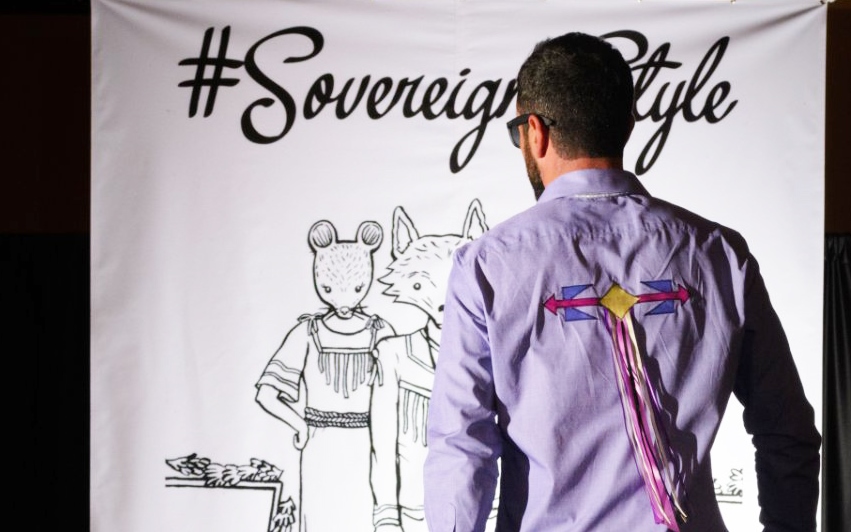
Suquamish Tribal Council Member Sammy Mabe was one of several elected officials to showcase ribbon apparel at the event.
by Angela Flemming
We want to thank all of you who joined us for the Suquamish Foundation’s inaugural Ribbons of Resilience fashion show at the Whitehorse Golf Course Ballroom on October 21st. This fun evening event celebrated Tribal history and traditions as well as the individual creativity and artistry of our community members. At the same time, it raised donations for and awareness of the Suquamish Foundation, which has supported programs and projects that benefit the Suquamish community since its’ inception in 2005.
An illuminated catwalk and a live deejay’s music mix featured the stylish modeling of male and female community members of all ages, as well as the full complement of the Suquamish Tribal Council, including Chairman, Leonard Forsman, and many of the very youngest and most adorable members of the Suquamish Tribe. Robin Sigo, Treasurer of the Suquamish Tribal Council and Director of the Suquamish Foundation, the non-profit branch of the Suquamish Tribal Government, emceed the event with obvious enjoyment, story-telling, infectious humor and pride. Each of the beautiful and original ribbon shirts, garments and baby outfits told an individual story through its colors, patterns and ribbons. Each, indeed, were wearable art pieces.
Ribbons for Resilience showcased beautiful ribbon shirt and dresses from many community members and families, including original multi-piece collections by E’thayta’ ae (LynDee Wells) and Xoputsee (Alaina Capoeman). Styles included traditional stars and salmon motifs, as well as contemporary Seahawks and Star Wars designs. One of the most hauntingly beautiful garments was a ledger art shirt, worn by Chairman Forsman, with an illustrated tribute to upholding sovereignty rights guaranteed in the treaty.
Our nearly 150-person audience engaged with the energy of the models and artistry of the garments with such enthusiasm and charitable generosity that we have already started planning for next year’s event. The Ribbons of Resilience event was joyful and beautiful. Again, we thank you for your attendance and for collaborating with us in continuing to support a diverse and cohesive community working together for positive change.
To see additional photos, please visit our online gallery at www.flickr.com/suquamish To donate or to order a # Sovereign Style shirt, please call Margeaux Lewis at (360) 394-8453.
Ocean to Table is a program at Chief Kitsap Academy designed to give students a hands-on learning experience that incorporates science and culture by taking them on the journey that fish make, from the ocean to their dinner tables.
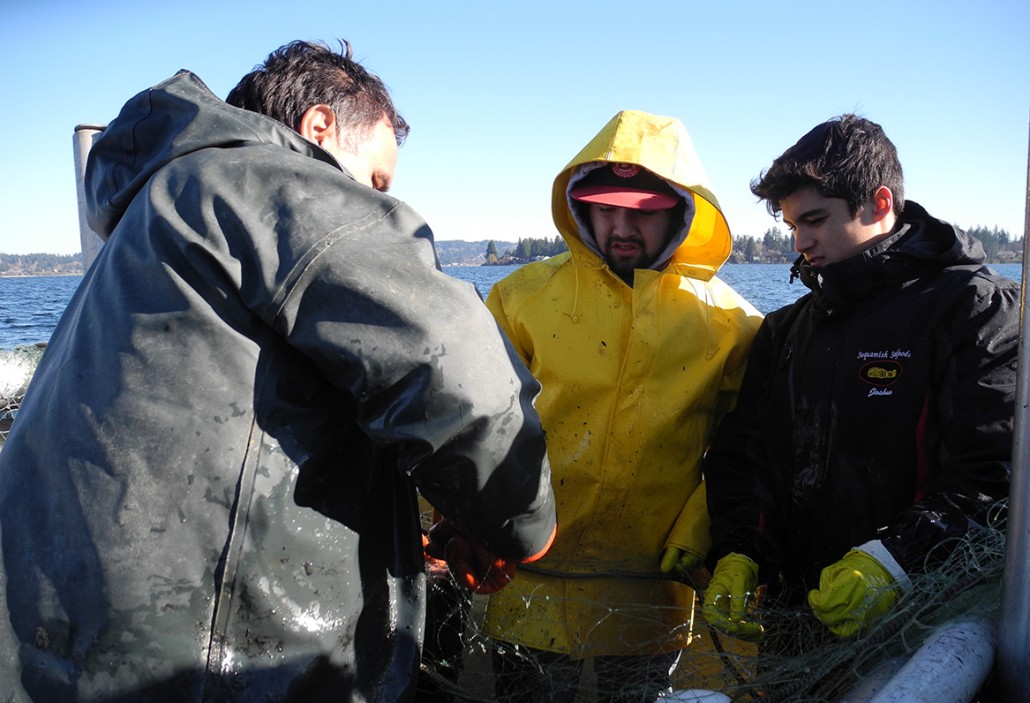
Suquamish Fisheries Director Rob Purser shows Chief Kitsap Academy Students how to maintain salmon fishing nets.
by Karen Matsumoto
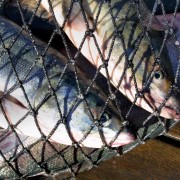
One very cold mid-November morning students in the marine biology class at Chief Kitsap Academy found themselves out on Dyes Inlet learning how to catch chum salmon. Jay Mills, his brother David, and Rob Purser provided the boats, equipment, and expertise, and generously gave their whole day to provide the first stage of a “start-to-finish” chum salmon fishing project. Students were prepared through classroom activities about outfitting a fishing boat. Boots and raingear provided by the school and loaned by the Tribal Fisheries Department, so students were ready to brave the cold and participate in a day of hard work on a gillnetter. The project ended days later with delicious salmon that was smoked, canned, and ready to eat.
This innovative activity was the brainchild of Tribal Councilmember and Kiana Lodge manager Jay Mills and Randi Purser, language and cultural teacher at CKA. They realized that although just about everybody loves smoked salmon, most students had no idea of the energy, patience, and effort it takes to produce one jar of smoked salmon.
The project was incorporated into the salmon unit of the CKA marine biology curriculum by Marine Biology teacher, Karen Matsumoto. Students learned about chum salmon life history early in the school year, and conducted macroinvertebrate sampling at Cowling Creek with Paul Dorn, Suquamish Fisheries biologist, and with biologists from the Washington Department of Fish and Wildlife and Kitsap County. Students also conducted stream habitat investigations, monitoring water chemistry and stream health. In late October, they saw chum salmon swimming upriver to spawn on Suquamish tribal lands for the first time in almost 100 years, thanks to the new fish ladder built by Trout Unlimited volunteers.
There was a field trip to the Grover Creek hatchery and classroom dissection activities. After investigating the internal anatomy of salmon, students practiced filleting the fish, an essential step in preparing them for smoking.
The November day on David’s and Jay’s boats included setting and pulling nets, disentangling salmon caught in the nets, and dealing with the unusual numbers of sea jellies encountered in Chico Bay. Over 50 salmon were caught that day and by the end of the afternoon, the students were throwing fish like Pike Place Market fish vendors! They helped pack the fish for processing and met at the Community House the salmon the following day to continue their work. Jay Mills taught students how to clean and prepare fish for smoking, using his grandmother’s trick of placing the salmon on a bed of ferns to hold the fish in place and absorb the blood. It was an all day effort to clean and process the fish, ending with the salmon fillets carefully packed with salt and sent to the smoker!
Students helped tend the fire in the smoker, and learned about the smoking process. When the fish was ready, we met Jay at the Kiana Lodge kitchen for canning. About half the fish was smoked, resulting in seven cases of pint jars of first-rate salmon. The flavor was heavenly! These jars will be used as gifts to honor speakers and elders who come to the school and some may be sold for a school fundraiser.
Inspired by the success of this venture, Karen and Jay are developing a chum salmon fishing curriculum, so the program can be streamlined and duplicated every year. This intensive project, extending over three weeks, was well worth the time and effort. Students gained hands-on experience in the Tribe’s local chum fishery, learned how to process and preserve salmon, and gained another important connection with their Tribal heritage.