

As students begin classes at Chief Kitsap Academy Sept. 2, they will be welcomed by a new engraved wood sign at the entrance of the campus that reads haʔł sləx̌il, or “Good day” in Lushootseed.
Created by woodworker David Kotz and incorporating the Coast Salish-style black and red CKA Bear, the word huy’ – or “Until we meet again” – is etched on the opposite side, so students will close out their day at school with Lushootseed as well.
The greeting is just one of more than 50 signs big and small installed across the CKA campus just before school kicked off, part of a broader effort to build a Lushootseed “speech community” at the school.
“This is just the beginning,” said Cassy George, the Suquamish Tribe’s Lushootseed Language Program Coordinator as she helped managed installations in late August. “It feels really good to see the signs going up. It’s a good beginning.”
A speech community on campus
The project grew from a Dual Language grant that worked in collaboration with the Language Department, CKA and Washington’s Office of Superintendent of Public Education. George worked closely with CKA Lushootseed teacher Brandy Boure to decide how to use the funds.

Language Program Coordinator Cassy George, lower right, works with CKA staff, along with design and installation crew, to place new signage at the school..
“We asked, how do we create a speech community at the school? We have to create supports for people to speak when they’re together. Where are they together? The Commons, the cafeteria, the carving shed — those became priorities.”
Together, they envisioned signage as a daily reminder that the language belongs in every corner of school life.
Indeed, classrooms, bathrooms, and other high-traffic areas also got their own Lushootseed placards as well.
Positive affirmations and traditional foods
For cook Skylene George, the cafeteria was the right place to highlight positive affirmations and traditional foods. “She wanted the kids to feel happy here,” George explained. “So there’s signs that says things like ‘Extend good thoughts,’ ‘We care about you,’ ‘You are healthy,’ ‘Be kind to others.’ ”
On another wall in the cafeteria, a new Lushootseed seasonal foods wheel will replace the English-only version that has hung there for years. The wheel names clams, salmon, berries, and other staples of the Suquamish diet across the four seasons. “It connects what we eat to the times of year. It’s part of how we’ve always understood the world,” said George.
Carvings, graphics, and teamwork
Other spaces include the carving shed, where teacher Bearon Old Coyote asked for signs with phrases to encourage safety and good energy in the work. The signs themselves blend artistry and digital design.
Graphic designer Albert Treskin created layouts for each piece, working with Sound Reprographics. “Albert has been there at every step,” George said. “He’s been amazing.”
Installation has been another collaboration. Facilities staff, including Jon Morsette and Junior Santos, provided insight on placement and helped mount the signs. “Their knowledge of the campus made all the difference,” George said. “It really took a whole team to get this done.”
Looking ahead
Initially the state grant was fo
r $39,000 but in the second year was reduced to $22,000 with a tightening of the budget. That means some areas like the basketball court will have to wait. George hopes to apply for more funding to add electronic signage in the future.
For now, she sees the installation as a turning point. “It’s powerful for our kids to see Lushootseed every day,” she said. “These signs remind us the language is alive — in our food, our seasons, our places, and in how we greet one another.”
By Jon Anderson
Suquamish News Staff Writer


The MOU establishes government-to-government relations between the sovereign nation and state agency
August 11, 2025
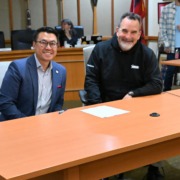
Suquamish, Wash. — The Suquamish Tribe and Washington State Department of Commerce signed a historic memorandum of understanding (MOU) establishing government-to-government relations between the tribe and the agency. The agreement removes administrative barriers, improves communications, implements culturally appropriate data privacy and security measures, and more. Suquamish Tribal Chairman Leonard Forsman and Commerce Director Joe Nguyễn signed the agreement on August 11 in Suquamish Tribal Council Chambers.
“This agreement reflects the deep trust and shared vision between the Suquamish Tribe and the Department of Commerce,” said Forsman. “By eliminating obstacles and committing to respectful, culturally informed collaboration, we are creating a stronger path forward — not just for our people, but for the local Kitsap community and beyond.”
Nguyễn said the MOU with the Suquamish Tribe is the seventh such agreement Commerce has made with tribal governments. Commerce anticipates similar agreements with additional tribes in Washington in the coming year.
“It is an honor to enter into this agreement with the Suquamish Tribe and strengthen our partnership, to memorialize the ways we can better honor their sovereignty, and to work alongside people who have cared for communities from time immemorial,” said Nguyen. “With priorities that range from affordable housing to culturally responsive health care, we celebrate and support the tribe’s work.”
Since his time as a state senator, Nguyễn has prioritized meeting with tribal leaders and community members. He’s deliberately listened to understand how the state, and now Commerce, can improve collaboration on priority issues. Nguyễn is committed to improving processes for applying for funding, streamlining and co-creating grant opportunities, and strengthening partnerships with tribal nations.
To learn more about The Suquamish Tribe, visit the Tribe’s website.
To learn more and follow Commerce’s work with tribal communities in Washington, visit the Office of Tribal Relations webpage.

Bringing lifetime of tribal education leadership full circle
After several years leading Neah Bay Middle and High School on the Makah Reservation, Lucy Dafoe has returned home to take the helm once again at Chief Kitsap Academy.
Dafoe previously served at CKA as both teacher and principal from 2014 to 2021, helping shape the school’s foundation on its current campus. Her return marks a new chapter, guided by decades of experience in tribal schools across the country and deep personal connections to the Suquamish community.
“I wasn’t looking for a new job,” Dafoe said. “But when the phone call came about this opening, I realized how much I missed being home — being close to family, being part of this community. It was a fast decision, but the right one.”
“Lucy made a significant impact during her previous administration, leading efforts that improved behavioral and academic outcomes and helped cultivate a culturally responsive and supportive school environment,” said Suquamish Education Division Director Brenda Guerrero.
“Her experience and vision will be instrumental as we continue building on our achievements and strive toward our collective goals.”
Longtime CKA admin Trish Chargualaf, who worked closely with Dafoe during her previous tenure in Suquamish, said she’s “very excited to see Lucy come back. It feels like a weight has been lifted.”
In Neah Bay, Dafoe oversaw grades 6 through 12 at the small but dynamic public school on the Makah Reservation. The role brought her full circle there as well — she started her teaching career there in 1994.
“The parents of my students had been my students,” she said. “And many of the staff had been my students, too. It gave me this incredible head start.”
Over her four years back in Neah Bay, Dafoe helped lead a cultural and academic revitalization. Under her leadership, students earned state championships in sports, hosted culturally centered summits with other schools, and saw many students graduating with both high school diplomas and Associate’s degrees.
The school integrated outdoor education, traditional foods, language, and carving into core academics. “It wasn’t culture or school—it was culture and school,” she said.
That blending of Native traditions with academic rigor has been the hallmark of Dafoe’s career. In addition to Neah Bay and Suquamish, she’s worked with the Puyallup and Seminole tribes, always with the goal of grounding education in place, language, and cultural values.
At Chief Kitsap Academy, she plans to reinvigorate that focus with outdoor classrooms, place-based learning, and curriculum that reflects Suquamish knowledge systems. “This is such a unique location,” she said. “We’re near the water, the forests, and so many resources. We should be using all of it to support our students’ growth — academically, culturally, socially.”
Dafoe also acknowledges the challenges ahead. “It’s no secret that these last few years have been difficult,” she said.
“Our students are still recovering from the pandemic. Behaviorally, emotionally, academically — we’ve all had to rebuild. My goal is to create a consistent, structured environment where staff are supported, kids are seen, and families feel welcome.”
She wants to emphasize proactive communication, community engagement, and a renewed academic push. “We’re going to focus on instruction,” she said. “State test scores show there’s work to be done. But that work happens when kids feel safe, when staff feel supported, and when families are included.”
A lifelong educator, Dafoe was raised in Joyce, Washington, and earned her degree in music education from Western Washington University. She is Paq’wt̓šən First Nations.
Now back home full-time, Dafoe is settling into her office, catching up with former colleagues, and beginning to lay the groundwork for a strong school year.
“I feel energized,” she said. “This is a school our students get to come to, not a place they have to go. I want CKA to be a place of belonging, where culture and learning walk side by side.”
By Jon Anderson
Suquamish News Staff Writer

BACK-TO-SCHOOL BBQ
Let’s start the year with excitement and joy!
WHEN: Thursday, August 7 from 10 am to 4:30 pm
WHERE: The Commons at Chief Kitsap Academy, 16341 Creative Drive, Poulsbo
INFO: Back-to-School Flyer
The Education Department will issue one gift card for school supplies for each tribal member (ages 4-18) who is enrolled in K-12.
The Human Services will provide each tribal member/descendant (ages 0-18) with one clothing gift card.